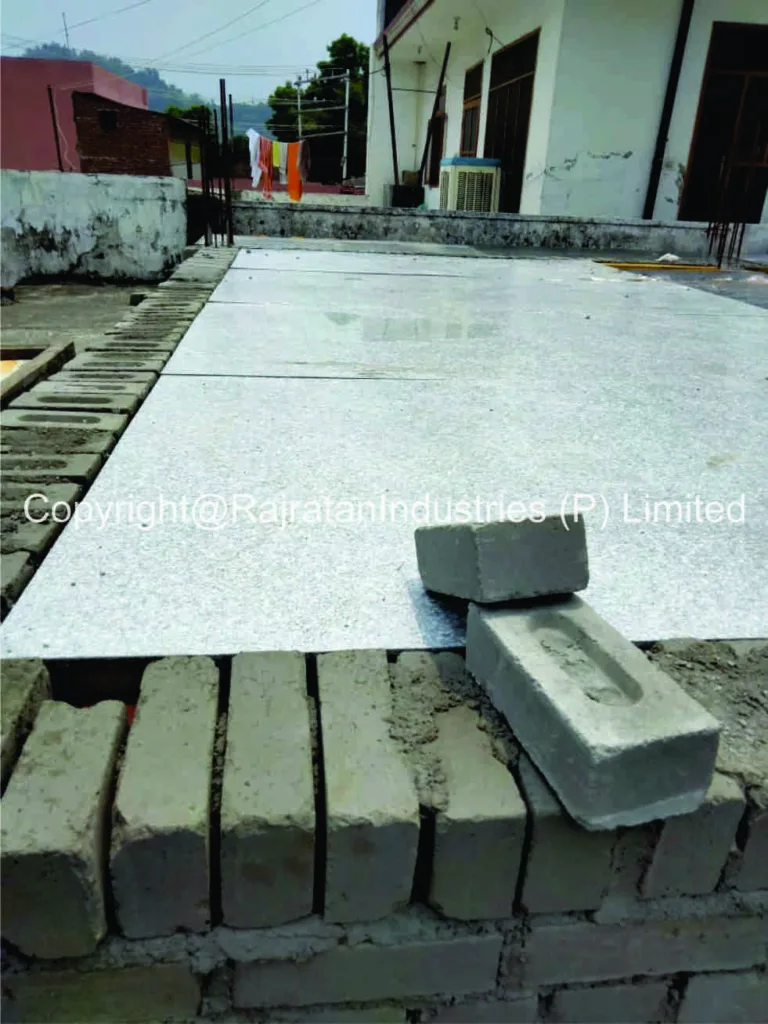
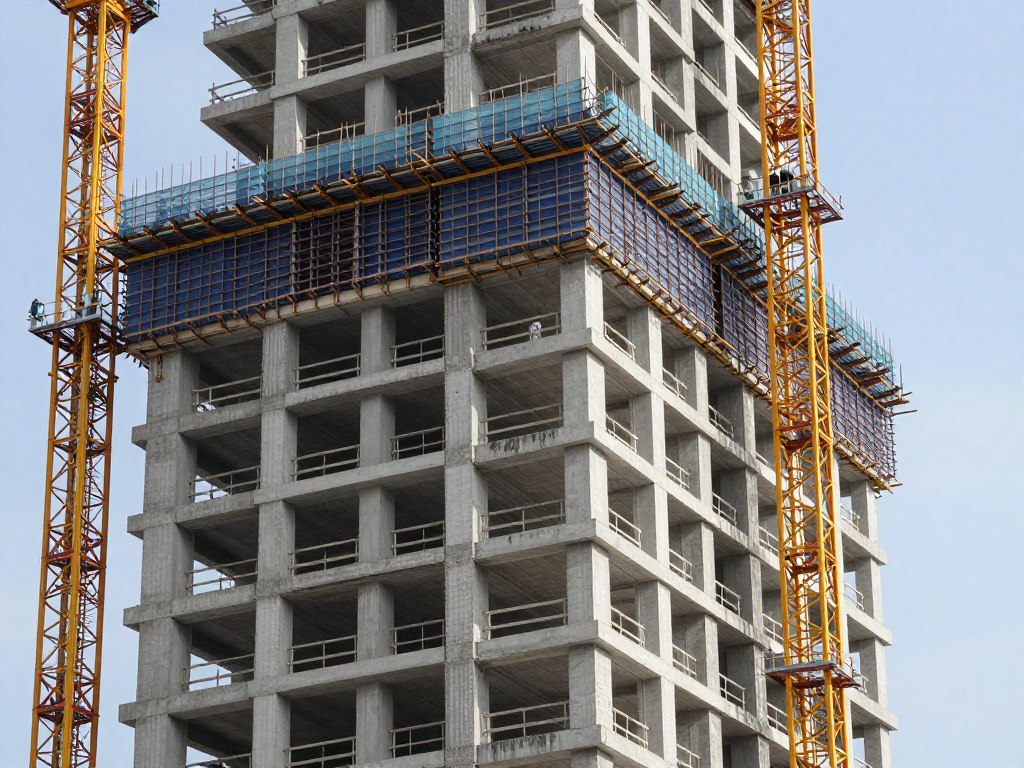
Staircase construction requires accurate measurements, proper support and reliable formwork. Unlike conventional slab shuttering, staircase formwork involves inclined surfaces, multiple riser panels, precise angle cuts and careful concrete placement.
One of the biggest challenges contractors face is maintaining dimensional accuracy while preventing formwork damage during repeated use.
Traditional plywood is commonly used for staircase shuttering. However, repeated exposure to moisture, concrete slurry and site handling can cause plywood edges to swell, surfaces to deteriorate and sheets to lose their original shape.
This is where PAC® Shuttering Boards by Rajratan offer an alternative.
Manufactured using a composite of industrial-grade plastics and reinforcing materials, PAC® boards are designed for waterproof performance, dimensional stability and repeated construction applications.
In this guide, we explain how to use a Plastic Centering Board for staircase waist slabs, side panels and risers, along with installation practices, material comparisons and cost considerations.
1. Understanding Staircase Shuttering and Its Requirements
Staircase shuttering is the temporary formwork system used to hold freshly poured concrete in the required shape until it gains sufficient strength.
A typical staircase formwork arrangement consists of three major components:
- Waist Slab Formwork
The inclined bottom surface of the staircase. It supports the concrete and reinforcement during casting.
- Riser Boards
Vertical panels installed between consecutive treads. They maintain the required step height and prevent concrete from flowing out.
- Side Formwork
Panels installed along the staircase edges to retain concrete and maintain the overall staircase profile.
Each component requires accurate alignment and adequate structural support.
Why Does Board Quality Matter?
During concrete placement, formwork experiences pressure from fresh concrete, vibration and construction activities.
A poor-quality shuttering board may result in:
- Uneven concrete surfaces.
- Bulging or misaligned risers.
- Leakage of cement slurry.
- Additional plastering and finishing work.
- Increased material replacement costs.
Therefore, selecting a suitable Heavy Duty Shuttering Board is important for achieving consistent results.
2. Why Consider PAC® Shuttering Boards for Staircase Formwork?
PAC® Shuttering Boards are manufactured by Rajratan using industrial-grade plastics, including PP, LDPE and HDPE, combined with reinforcing materials such as aluminium oxide and cross-linked polymers.
Unlike conventional plywood, PAC® boards have a non-porous composite structure that provides resistance to water absorption.
This makes them suitable for construction applications where repeated exposure to moisture and concrete is expected.
Key Advantages of PAC® Boards
Waterproof Performance: The boards do not absorb water like conventional plywood, helping maintain their dimensions during repeated applications.
Dimensional Stability: They are designed to retain their shape during regular site use.
Smooth Surface Finish: Their smooth surface supports consistent concrete finishing and easier formwork removal.
Multiple Reuses: Depending on the grade and site handling, PAC® ECOPRIME boards offer different reuse capacities.
Cutting Flexibility: Boards can be cut into smaller panels for staircase risers, side supports and other formwork applications.
Buyback Programme: Eligible used boards and offcuts can be returned under Rajratan’s 40% buyback credit programme, subject to applicable terms.
3. Plywood vs PAC® Shuttering Board: A Detailed Comparison
Choosing between plywood and a plastic-based construction shuttering board requires looking beyond the initial purchase price.
Water resistance, reuse potential, maintenance and cost per application are equally important.
Comparison | Marine Plywood | PAC® ECOPRIME Standard | PAC® ECOPRIME Premium |
Water Resistance | Prone to edge swelling | Waterproof | Waterproof |
Typical Reuse | 4–6 times | 30–40 times | 60–100+ times |
Density | Approx. 650 kg/m³ | 1100 kg/m³ | 1320 kg/m³ |
Indicative 12mm Price | ₹45–₹55/sq. ft. | ₹80/sq. ft. | ₹90/sq. ft. |
Maintenance | Higher with repeated use | Lower | Lower |
Buyback Credit | Not included | Up to 40% | Up to 40% |
Note: Prices and reuse figures are indicative and should be confirmed with the manufacturer. Actual performance depends on handling, installation, support spacing and site conditions.
The main advantage of PAC® boards is their potential to reduce the cost of each formwork application through repeated use.
4. Cost Comparison: Plywood vs PAC® Boards
The initial purchase price does not always represent the actual cost of a shuttering material.
For contractors, the more useful calculation is the cost per use.
Let’s consider a standard 8 ft × 4 ft sheet covering 32 sq. ft.
A. 12mm Marine Plywood
- Sheet size: 8 ft × 4 ft.
- Approximate rate: ₹50/sq. ft.
- Total sheet cost: ₹1,600.
- Assumed reuse: 5 times.
Cost per use: ₹1,600 ÷ 5 = ₹320 per sheet.
B. PAC® ECOPRIME Standard
- Sheet size: 8 ft × 4 ft.
- Approximate rate: ₹80/sq. ft.
- Total sheet cost: ₹2,560.
- Assumed reuse: 35 times.
Cost per use: ₹2,560 ÷ 35 = approximately ₹73 per sheet.
C. PAC® ECOPRIME Premium
- Sheet size: 8 ft × 4 ft.
- Approximate rate: ₹90/sq. ft.
- Total sheet cost: ₹2,880.
- Assumed reuse: 60 times.
Cost per use: ₹2,880 ÷ 60 = ₹48 per sheet.
Cost Per Application Comparison
Material | Cost Per Sheet | Assumed Uses | Cost Per Use |
Marine Plywood | ₹1,600 | 5 | ₹320 |
PAC® ECOPRIME Standard | ₹2,560 | 35 | ₹73 |
PAC® ECOPRIME Premium | ₹2,880 | 60 | ₹48 |
These calculations demonstrate why contractors should evaluate shuttering materials based on their total usable life rather than only the purchase price.
Additional Advantage: 40% Buyback Credit
Rajratan also offers a 40% buyback credit programme on eligible PAC® boards.
When boards reach the end of their usable life, customers can return eligible used material and receive credit against a new purchase, subject to programme conditions.
This provides an additional economic benefit and supports material recovery.
5. Step-by-Step Guide to Staircase Shuttering Using PAC® Boards
Installing PAC® boards for staircase formwork follows conventional shuttering practices. However, accurate measurements, appropriate fixing and adequate support are essential.
Step 1: Prepare the Support Structure
Begin by preparing the temporary support system beneath the inclined staircase.
- Install suitable steel props or scaffolding according to the approved formwork design.
- Position longitudinal runners or stringer supports along the staircase slope.
- Check the inclination and soffit level using a level instrument.
- Ensure the support structure is stable and properly braced.
Support spacing must be determined according to the board thickness, concrete loads, span and approved formwork design. Do not use a universal spacing without checking the actual site requirements.
Step 2: Install the Waist Slab Bottom Formwork
The waist slab bottom formwork creates the inclined underside of the staircase.
- Select suitable 12mm or 18mm PAC® boards according to the structural and formwork requirements.
- Position the sheets over the prepared supporting runners.
- Align the board edges to minimise gaps.
- Secure the sheets using an appropriate fixing arrangement.
- Check the entire inclined surface for alignment and stability.
The selected board thickness and fixing method should be approved for the expected concrete pressure and construction loads.
Step 3: Fix the Side Panels
Side panels help maintain the staircase profile and retain concrete during casting.
- Install PAC® boards along the open sides of the staircase.
- Mark the tread and riser dimensions using a measuring tape, chalk line and carpenter’s square.
- Verify the step profile against the approved staircase drawing.
- Provide suitable cleats and bracing to hold the panels in position.
Accurate marking at this stage helps maintain uniform step dimensions.
Step 4: Cut and Install the Riser Boards
Riser boards are vertical panels that separate consecutive staircase steps.
- Measure the required riser height and staircase width.
- Cut PAC® boards into appropriately sized strips.
- Use a suitable carbide-tipped circular saw blade for clean cutting.
- Position each riser panel vertically according to the staircase layout.
- Secure the panels with suitable supports and fixings.
- Check each riser for vertical alignment and uniform height.
A properly designed fixing and bracing arrangement helps prevent movement or deformation during concrete placement.
Step 5: Inspect Before Concrete Pouring
Before starting concrete placement, inspect the entire formwork assembly.
Check the following:
- All props and supports are stable.
- Side panels are properly secured.
- Riser heights are consistent.
- Board joints are adequately sealed.
- Reinforcement and cover arrangements are correct.
- The formwork is clean and free from loose material.
A final inspection helps identify alignment or support problems before concrete placement begins.
Step 6: Concrete Pouring and De-Shuttering
Once the formwork and reinforcement are approved, concrete placement can begin.
- Apply a suitable release agent if required.
- Place concrete in a controlled sequence according to the approved concreting method.
- Use a concrete vibrator carefully without directly striking the shuttering panels.
- Monitor the riser panels and supports during placement.
- Remove the formwork only after the concrete has achieved the required strength and the responsible engineer has approved removal.
- Clean the PAC® boards and store them properly for subsequent use.
Important: De-shuttering time should never be decided by a fixed 24–48-hour rule. It depends on concrete strength, temperature, structural design, span and the type of formwork being removed.
6. Practical Tips for Cutting, Fixing and Maintaining PAC® Boards
Correct handling plays an important role in achieving the expected reuse life of a shuttering board.
Here are some practical recommendations:
Use Suitable Cutting Equipment
Use an appropriate carbide-tipped circular saw blade and cutting setup to obtain clean edges and minimise material damage.
Maintain Proper Edge Distance
Avoid placing nails or screws too close to the board edges. Select suitable fasteners and edge distances according to the manufacturer’s recommendations.
Ensure Proper Support
Use an appropriate support arrangement to prevent excessive deflection during concrete placement and vibration.
Clean After Every Use
Remove concrete residue after de-shuttering using suitable cleaning tools and manufacturer-approved cleaning methods.
Store Boards Correctly
Keep boards flat and properly supported. Avoid unnecessary bending, dragging and impact damage.
Retain Smaller Offcuts
Store reusable cut pieces separately. Eligible offcuts may also be considered under Rajratan’s 40% buyback credit programme, subject to its terms and conditions.
7. Where Else Can PAC® Shuttering Boards Be Used?
One advantage of PAC® boards is their versatility across different formwork applications.
Apart from staircase construction, they can be used for:
Column Shuttering: For creating temporary moulds around reinforced concrete columns.
Beam Shuttering: For forming beam sides and bottom surfaces.
Slab Formwork: For suitable horizontal formwork applications with properly designed supports.
Lift Shaft Formwork: For creating formwork panels in vertical construction areas.
Wall Formwork: For suitable concrete wall shuttering applications.
The selection of board thickness, support spacing and fixing arrangements should always depend on the application and engineering requirements.
8. Ordering PAC® Shuttering Boards from Rajratan
Rajratan Industries Private Limited manufactures PAC® Shuttering Boards at its facility in Indore, Madhya Pradesh.
The ECOPRIME range is available in different grades to meet varying construction and formwork requirements.
PAC® ECOPRIME Product Range
ECOPRIME STANDARD
- Density: 1100 kg/m³.
- Typical repetitions: 30–40.
- Suitable for contractors looking for repeated formwork applications.
ECOPRIME PREMIUM
- Density: 1320 kg/m³.
- Typical repetitions: 60–100+.
- Designed for demanding applications requiring higher reuse potential.
Both grades are available in 12mm and 18mm thickness options, subject to product availability.
Trial Orders for Contractors
Contractors who want to evaluate PAC® boards before placing larger orders can consider a trial quantity of 5–10 sheets.
Testing the material in suitable applications can help assess:
- Cutting performance.
- Fixing and nail-holding behaviour.
- Surface finish.
- Cleaning requirements.
- Reuse performance.
Ordering and Dispatch
Rajratan supplies PAC® Shuttering Boards across India through established logistics partners.
For current pricing, availability, payment terms and transportation details, contact the Rajratan sales team.
Explore the PAC® ECOPRIME range:
https://shutteringboard.rajratan.in/
9. Frequently Asked Questions About Staircase Shuttering with PAC® Boards
Q1. Can PAC® boards be used for staircase shuttering?
Yes. PAC® Shuttering Boards can be used for suitable staircase formwork applications, including waist slab bottoms, side panels and riser boards. Proper support and fixing arrangements are essential.
Q2. Does cutting a PAC® Shuttering Board affect its waterproof properties?
PAC® boards have a composite structure designed to resist water absorption throughout the material. Cutting does not expose a conventional plywood-type absorbent core. Edges should still be inspected for damage after cutting.
Q3. Which thickness is suitable for staircase shuttering: 12mm or 18mm?
Both 12mm and 18mm boards are available. The appropriate thickness depends on the application, support spacing, concrete pressure and formwork design. The final selection should be made according to engineering requirements.
Q4. How many times can PAC® Shuttering Boards be reused?
PAC® ECOPRIME Standard typically offers 30–40 repetitions, while ECOPRIME Premium offers 60–100+ repetitions. Actual reuse depends on installation, handling, cleaning and storage practices.
Q5. Can PAC® boards be used for both risers and beam shuttering?
Yes. Suitable PAC® boards can be reused across different formwork applications, including staircase risers, beam shuttering and column shuttering, provided the selected thickness and support arrangement meet the application requirements.
Q6. Are PAC® Shuttering Boards waterproof?
Yes. PAC® boards are designed to be waterproof and resist water absorption, making them suitable for construction environments involving repeated moisture exposure.
Q7. Does Rajratan offer a buyback programme for PAC® boards?
Yes. Rajratan offers a 40% buyback credit programme on eligible used PAC® boards. The applicable return conditions and credit terms should be confirmed with the company.
Q8. Can contractors order sample quantities of PAC® boards?
Yes. Contractors can enquire about trial orders of approximately 5–10 sheets to evaluate the material under their site conditions before placing larger orders.
Conclusion: Choose a Shuttering Board Designed for Repeated Construction Use
Staircase formwork requires accurate dimensions, reliable support and materials that can withstand repeated site applications.
While conventional plywood remains a commonly used shuttering material, PAC® Shuttering Boards provide an alternative with waterproof performance, dimensional stability and higher reuse potential.
With its ECOPRIME Standard and Premium variants, Rajratan offers options for contractors looking to improve formwork efficiency and manage material costs across multiple construction projects.
Looking for a reliable Plastic Centering Board for your next construction project?
Explore PAC® Shuttering Boards by Rajratan and connect with our team to discuss your project requirements.