PAC® Shuttering Boards: Sustainable Green Building Without Compromise
Why Green Building Needs PAC® Shuttering Boards
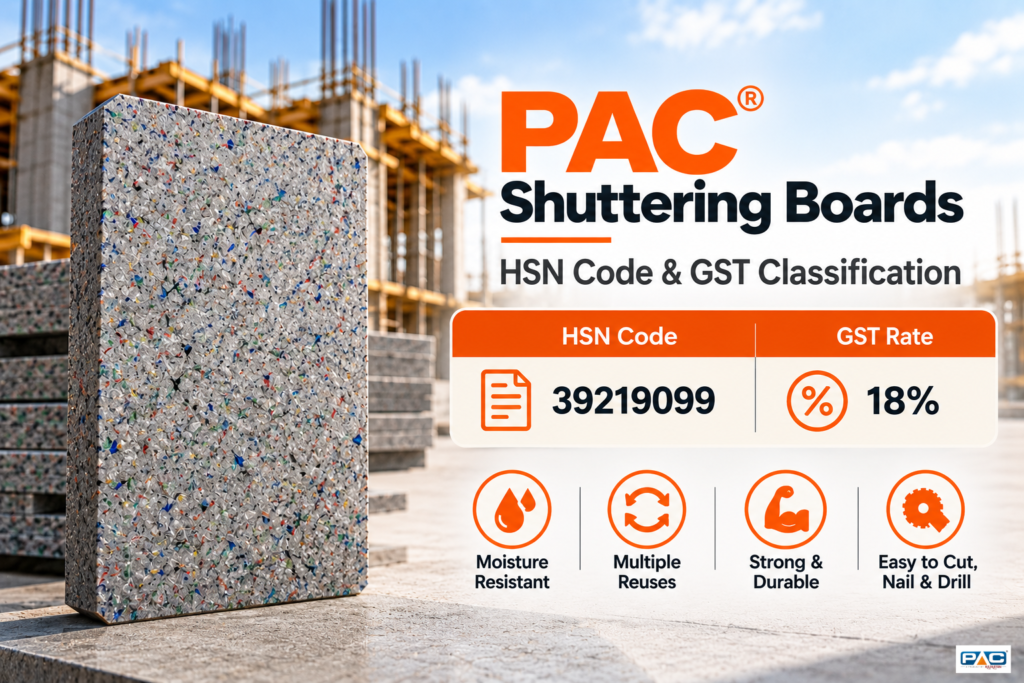
Indian construction is at a crossroads: developers face mounting pressure to meet LEED/IGBC green certifications, municipal regulations demand waste reduction, and timber formwork costs consume 15–18% of project budgets while generating 40+ tonnes of waste per 10,000 sq.m. of structure. PAC® Shuttering Boards provide a sustainable Construction Shuttering Board solution through their 100% recycled plastic composition, 60+ reuse cycles, and a 40% buyback credit that turns waste into recovered asset value.
The Environmental Impact: Closing the Formwork Loop
Traditional timber formwork represents true consumption: a sheet lasts 5–8 uses before splintering, warping, or absorbing water. Over a 10,000 sq.m. project, you generate 35–50 tonnes of scrap wood destined for landfill or informal burning. PAC® boards are engineered from diverted industrial packaging waste (Patanjali, Nestlé production lines)—materials that would otherwise be incinerated. Each board delivers 60+ reuse cycles, zero deforestation, and eliminates the timber supply chain entirely.
Circular Economy in Action: After 40–60 cycles, old boards retain 40% material value. Return them to Rajratan, receive credit against new purchases. You’re not discarding; you’re recovering. This closed-loop model directly aligns with LEED MR Credit (Material Reuse) and IGBC Circular Economy mandates.
Green Building Compliance Made Simple
| Certification Target | PAC® Board Alignment | Competitive Alternative (Timber) |
|---|---|---|
| LEED MR: Material Reuse (5 pts) | ✓ 100% recycled content; 60+ reuses; 40% buyback recovery | ✗ Timber: single-use or 5–8 cycles max |
| LEED MR: Circularity (2 pts) | ✓ Closed-loop take-back program; zero landfill scrap | ✗ Timber: 80% waste to landfill |
| IGBC Waste Mgmt (3–5 pts) | ✓ Reduces on-site formwork waste by 85% | ✗ Timber: generates continuous scrap piles |
| Carbon Footprint Reduction | ✓ Eliminates forest extraction; reuse eliminates transport cycles | ✗ Timber: ~0.8 kg CO₂ per kg of wood harvested |
Workability Parity: No Retraining, Same Speed
PAC® boards nail, cut, and screw exactly like timber plywood. Your crews require zero retraining. Carpenters strip formwork at identical cycle times (24–48 hours post-pour). Rebar placement, tie-wire patterns, and pour sequencing remain unchanged. This eliminates the hidden cost of contractor retraining and the productivity loss during transition periods.
Real-World Speed Comparison: A typical 2,000 sq.m. slab formwork setup takes 6–8 hours with both timber and PAC® boards. Recovery happens at 36–40 hours post-cure. No delay; no learning curve.
Technical Durability & Structural Certainty
| Property | PAC® (NABL Certified) | Why It Matters |
|---|---|---|
| Compressive Strength | 22.0 N/mm² | Supports heavy RCC loads without deflection or cracking |
| Water Absorption | 0% (zero swelling) | Infinite submersion; eliminates pour-day delays from moisture swelling |
| Static Load Capacity | 7500 kg per board | Eliminates secondary shoring; reduces structural failure risk |
| Repetitions | 60+ cycles (Premium Black) | Amortizes cost over 60 uses; timber: 5–8 uses before failure |
| Moisture Stability | 0.33–0.64% | Prevents dimensional movement during cure; zero secondary plastering |
Cost Transparency & ROI Reality
Pricing Tiers (Ex-Factory, Indore):
- 12mm Standard White: ₹80/sq.ft. (~40 kg/sheet, 30–40 reuses)
- 12mm Premium Black: ₹90/sq.ft. (~45 kg/sheet, 60+ reuses)
- 18mm Column Board: ₹125/sq.ft. (Heavy-duty formwork)
ROI Calculator Example (2,000 sq.m. project):
- Total board area: ~2,200 sq.m. (accounting for beam/column boxing)
- PAC® Premium Black @ ₹90/sq.ft. = ₹21.78 lakh upfront
- Timber plywood (15mm @ ₹65/sq.ft. × 6–8 uses) = ₹28.6 lakh total cost of ownership
- PAC® Savings: ₹6.8 lakh + 40% buyback credit = additional ₹8.7 lakh recovered
- Net Advantage: ₹15.5 lakh (54% cost reduction over project lifecycle)
Delivery: TCI Freight, VRL Logistics, Safexpress. Standard loose shipment (boards withstand any transit handling). Bulk order discounts: 5–10% for 200+ sheets.
The Green Building Momentum in India
India’s green building movement is no longer aspirational—it’s regulatory. The Ministry of Housing and Urban Affairs now mandates IGBC or LEED certification for all centralized government projects. Corporate ESG commitments drive private developers toward Material Reuse and Circular Economy compliance. Municipal waste-reduction bylaws in Bangalore, Hyderabad, and Pune penalize single-use formwork waste. PAC® Shuttering Boards position your project as compliant, sustainable, and cost-optimized—without sacrificing construction speed or structural integrity.
Next Step: Calculate Your Project ROI
Download our free ROI calculator to compare timber waste cycles vs. PAC® circular model economics. Input your slab area, pour frequency, and local timber pricing—see exact payback timelines and LEED/IGBC credit alignment for your specifir
Conclusion
PAC® Shuttering Boards provide a sustainable alternative to traditional timber formwork, combining repeated reuse, moisture resistance and a circular buyback model. By reducing formwork waste and extending material life, they can help construction projects lower long-term costs while supporting green building and circular economy goals.
Build Greener. Reuse More. Waste Less.