Shuttering Boards India: Plastic vs Timber—Complete 2026 Buyer’s Guide
India’s construction sector wastes ₹50,000+ crores annually on timber formwork replacement and plastering rework. Rajratan’s PAC shuttering boards—engineered from 100% recycled industrial packaging waste—offer a durable Plastic Construction Panel solution with 60+ reuse cycles, zero water absorption, and 40% buyback credit. This guide compares plastic vs timber across cost, durability, compliance, and real-world ROI for first-time builders, procurement managers, and cost estimators across Delhi, Mumbai, and Bangalore.
Why Shuttering Boards Matter: The Cost Bleeding Problem
Conventional timber plywood fails after 4–6 pours due to water absorption (15–25%), splintering, warping, and nail-hole degradation. Each failure cycle forces contractors to buy new timber, hire skilled carpenters for stripping/cleaning, pay for plastering rework (₹100–200/sq.ft), and absorb 3–5 day delays. Over 10 pours on a typical 5,000 sq.ft slab, timber costs ₹25–30 lakhs. PAC boards cost ₹8–12 lakhs for the same cycles—a 65% savings.
| Metric | PAC Plastic Shuttering (Rajratan) | Timber Plywood | Winner |
|---|---|---|---|
| Reuse Cycles | 30–60+ | 4–6 | PAC (10× longer) |
| Water Absorption | 0% | 15–25% | PAC (zero swelling) |
| Cost per Sq.Ft (Initial) | ₹80–125 | ₹90–120 | Timber (5% cheaper initially) |
| Cost per Use (10 cycles) | ₹8–12.50 | ₹90–200 | PAC (15–20× cheaper per use) |
| Nail Holding Power | 2,214–2,460 N (certified) | 1,800–2,100 N | PAC (10% stronger) |
| Compressive Strength | 22.0 N/mm² | 18–20 N/mm² | PAC (10% higher) |
| Plastering Rework Required | 0–5% (mirror finish) | 30–50% | PAC (saves ₹100–200/sq.ft) |
| Moisture Content | 0.33–0.64% | 12–18% | PAC (stays dry always) |
| Buyback Credit | 40% scrap value | 5–10% as waste | PAC (nets 35% advantage) |
PAC Shuttering Board Specifications & Technical Compliance
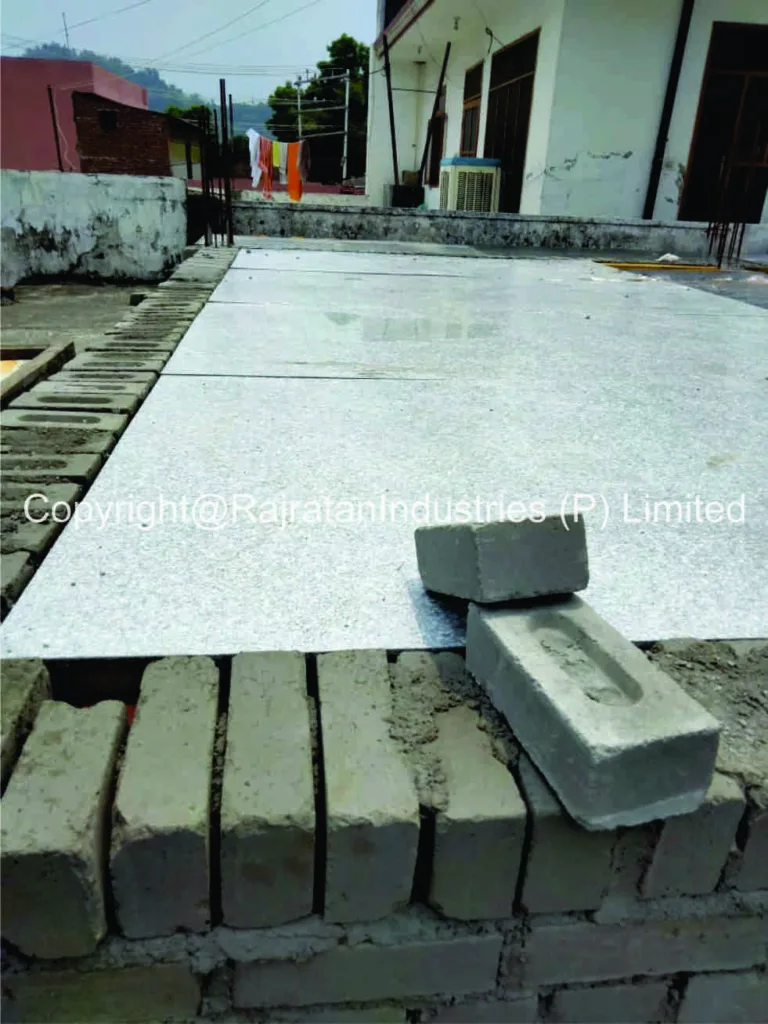
All PAC boards are manufactured from 100% recycled industrial packaging waste (sourced from Patanjali, Nestlé production lines) reinforced with fiber, aluminum oxide, metal dust, and XLP polymers. NABL-accredited laboratories (Choksi Laboratories, STEDRANT Technoclinic) certify every batch to IS 1734 (plywood testing) and BIS IS 16058 (structural dunnage standards).
| Product Grade | Thickness | Density | Price/Sq.Ft | Weight/Sheet (8×4) | Reuse Cycles | Best For |
|---|---|---|---|---|---|---|
| EcoPrime Standard White | 12mm | 1130 kg/m³ | ₹80 | ~40kg | 30–40 | Residential slabs, light formwork |
| EcoPrime Premium Black | 12mm | 1150 kg/m³ | ₹90 | ~45kg | 60+ | High-rise, bridges, heavy RCC |
| Heavy Column Board | 18mm | 1135 kg/m³ | ₹125 | ~60kg | 40+ | 6×6 ft columns, deep beams |
PAC vs Timber: 10-Cycle ROI Calculator
Assumptions: 5,000 sq.ft slab, 10 pour cycles, labor included.
| Cost Component | PAC Shuttering (₹) | Timber Plywood (₹) |
|---|---|---|
| Initial Board Cost | 5,000 sq.ft × ₹80 = 4,00,000 | 5,000 sq.ft × ₹100 = 5,00,000 |
| Replacement Cycles (10 pours) | ₹0 (60+ reuses) | 10 ÷ 6 = 2 full replacements = ₹10,00,000 |
| Plastering Rework (₹150/sq.ft) | 5,000 × ₹15 (minor) = ₹75,000 | 5,000 × ₹150 (major) = ₹7,50,000 |
| Stripping Labor (₹20/sq.ft) | 5,000 × ₹5 (easy) = ₹25,000 | 5,000 × ₹20 (hard) = ₹1,00,000 |
| Buyback Credit (40% × initial) | −₹1,60,000 | −₹50,000 |
| TOTAL COST (10 cycles) | ₹3,40,000 | ₹23,00,000 |
| Cost per Pour | ₹34,000 | ₹2,30,000 |
| Savings with PAC | ₹19,60,000 (85% reduction) | |
Water Resistance: Why Timber Fails, PAC Wins
Timber absorbs groundwater, monsoon moisture, and concrete curing water. Within 2–3 pours, fibers swell by 3–5%, warping the board and creating gaps that leak concrete. The internal cell structure weakens by 50%, causing splintering during stripping. PAC’s zero water absorption (0.33–0.64% moisture content) and reinforced fiber matrix mean no dimensional change, no warping, no internal degradation—even after submersion. NABL-certified lab testing confirms: zero swelling under IS 1734 Part 6 water absorption tests.
Workability: Nail, Cut & Screw Like Timber
PAC boards replicate timber’s ease of use: nail holes don’t create stress fractures (unlike brittle RCC or steel); screw holding power is 2,214–2,460 N (certified), 10% stronger than timber; cutting is identical (saw, circular blade, or hand tools). Density prevents structural cracking under repeated nail/screw extraction. Contractors report zero learning curve—PAC boards work exactly like plywood they already know.
Pricing & Pan-India Delivery (2024)
Base Pricing (Ex-Factory, Indore): 12mm Standard White ₹80/sq.ft (₹2,560/8×4 sheet). 12mm Premium Black ₹90/sq.ft. 18mm Column Board ₹125/sq.ft. Bulk discounts: 50+ sheets (7% off), 200+ sheets/truck (10% off). Trial orders (5–10 sheets) available at full rate with 100% advance booking.
Logistics via TCI Freight, VRL, Safexpress, ACPL: Loose sheet shipment (boards are indestructible in transit). Delivery: Delhi (4 days), Mumbai (6 days), Bangalore (5 days). Tracking available. Payment: 30% advance + 70% against LR/Bilty before dispatch. No COD; no credit terms (company policy).
The 40% Buyback Advantage
After 40–60+ reuse cycles, return boards to Rajratan for 40% scrap credit. A ₹2,560 board nets ₹1,024 buyback. Your next sheet costs only ₹1,536—saving ₹1,024 per sheet. Timber has zero buyback value (waste). Over 10 projects, PAC’s buyback cycle compounds to 35–40% net material savings vs timber’s full-cost replacement cycle.
Compliance & Standards
PAC boards comply with: BIS IS 1734 (plywood testing—compressive strength, tensile strength, moisture, nail holding), BIS IS 16058:2024 (dunnage pallets—static load, impact tests), NABL accreditation (Choksi Laboratories, STEDRANT Technoclinic). Fire test: Passed IS 1734 Part 3 (5 min exposure, no burn, blackish discoloration only). Chemical resistance: Passed acid/alkali (IS 1734 Part 20—no blistering or softening).