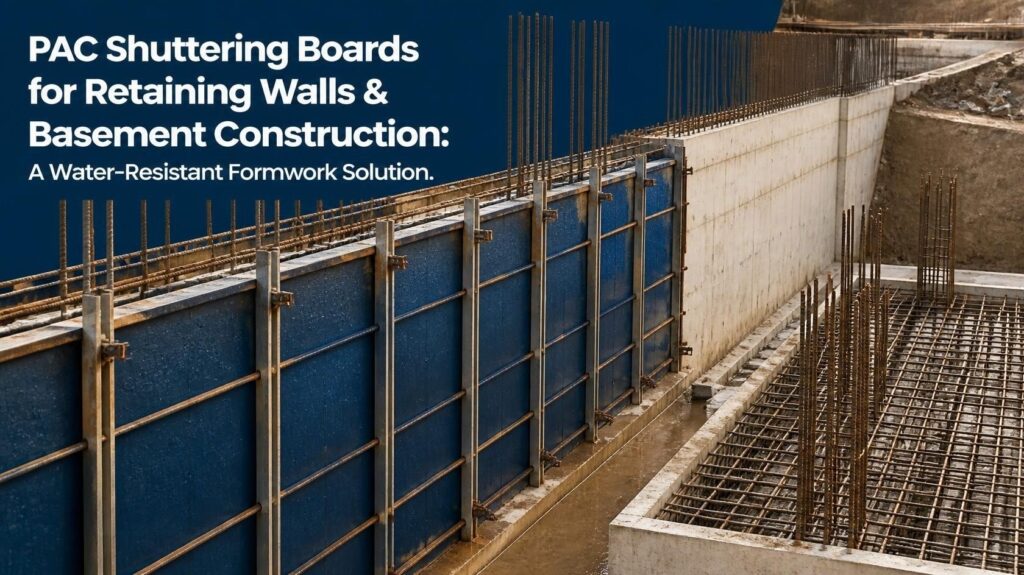
Retaining walls and basement structures are exposed to demanding construction conditions. Groundwater, rain, moisture, hydrostatic pressure and repeated concrete pours can put considerable stress on conventional shuttering materials.
For contractors working in these environments, the choice of formwork board can directly affect surface finish, repetition cycles, handling and overall project cost.
PAC® Shuttering Boards are designed as a reusable alternative to conventional timber-based shuttering plywood. Their resistance to moisture, dimensional stability and repeated usability make them suitable for applications where conventional plywood may face swelling, delamination or deterioration.
Why Shuttering Material Matters in Basement and Retaining Wall Construction
Basement and retaining wall construction often takes place in areas where moisture is difficult to avoid. Even when proper waterproofing is provided, shuttering boards can come into contact with wet concrete, groundwater, rain or damp working conditions.
Traditional plywood can absorb moisture over repeated use. Depending on the plywood grade, exposure conditions and handling, this may contribute to:
- Swelling and dimensional changes
- Surface deterioration
- Delamination
- Edge damage
- Reduced number of usable repetitions
- Additional maintenance and replacement costs
PAC® Shuttering Boards are manufactured to provide a more moisture-resistant formwork surface, helping contractors maintain consistent performance across repeated concrete pours.
PAC® Shuttering Board vs. Conventional Timber Plywood
The practical difference becomes more important when shuttering is repeatedly exposed to moisture.
Property | PAC® Shuttering Board | Timber Plywood* |
Moisture resistance | High | Depends on grade |
Water absorption | Low, based on tested samples | Varies by grade and exposure |
Compressive strength | Up to 22.0 N/mm²** | Varies |
Density | Approx. 1130–1150 kg/m³** | Typically lower |
Reusability | Approximately 30–60+ repetitions depending on grade and application | Varies significantly |
Swelling / delamination | Designed to resist these issues | Possible with prolonged moisture exposure |
Machining | Can be cut, drilled and fastened similar to timber | Familiar to construction teams |
Buyback option | 40% buyback program* | Generally not applicable |
*Actual performance depends on plywood grade, construction conditions, handling and application.
**Values should be considered against the applicable product test report/specification for the particular PAC® board grade.
Technical Performance of PAC® Shuttering Boards
PAC® Shuttering Boards are manufactured using a composite material system incorporating industrial-grade polymers and reinforcing components.
Available laboratory test data for specific PAC® board samples includes:
Test Property | Reported Value |
Compressive Strength | 22.0 N/mm² |
Density | 1130–1150 kg/m³ |
Moisture Content | 0.33–0.64% |
Tensile Strength | 11.30–11.89 N/mm² |
Modulus of Rupture | 11.34–12.92 N/mm² |
Nail Holding Power | 2214–2460 N |
Water Swelling | No significant swelling reported in tested samples |
These values are useful for understanding the material’s mechanical and moisture-related performance. However, contractors should always refer to the current product-specific test report and recommended application guidelines before specifying a board for a structural formwork application.
Why Moisture Resistance Matters for Basements
Basement construction presents a different set of challenges compared with ordinary above-ground work.
Concrete formwork may encounter:
- Groundwater
- Wet excavation conditions
- Rainwater
- High humidity
- Wet concrete
- Repeated cleaning and washing
A shuttering board that maintains its dimensions despite repeated moisture exposure can help provide a more consistent formwork surface.
PAC® boards are designed to resist moisture-related swelling and deterioration, making them suitable for projects where conventional plywood may require more frequent replacement.
Applications in Retaining Walls
Retaining walls require formwork capable of handling the pressure generated by freshly placed concrete.
PAC® Shuttering Boards can be used for suitable retaining-wall formwork applications where the required thickness, support system and load calculations are properly designed.
Typical applications include:
- RCC retaining walls
- Basement walls
- Boundary and compound walls
- Foundation structures
- Lift-pit walls
- Water-related construction areas
- Industrial retaining structures
- Repetitive wall formwork
The board itself is only one component of the formwork system. Proper supports, tie rods, walers, studs and spacing must be designed according to the concrete pressure and project requirements.
Suitable for Basement Construction
For basement projects, shuttering material needs to withstand repeated exposure to damp conditions while maintaining a usable surface.
PAC® Shuttering Boards can be considered for:
Basement Walls
The boards provide a stable formwork surface for repeated wall casting, subject to the project’s structural formwork design.
Column Formwork
18 mm boards can be considered for applications requiring a thicker formwork panel, depending on the project requirements.
Lift Pits
Lift-pit construction can involve difficult and damp working conditions. A moisture-resistant board can reduce some of the problems associated with conventional plywood.
Foundation and Substructure Work
PAC® boards can also be used in suitable foundation and substructure applications where repeated formwork is required.
Reusability Can Reduce Formwork Cost
One of the biggest advantages of reusable shuttering is that the initial purchase price does not tell the complete cost story.
A board costing more initially may become economical when it can be reused over a greater number of concrete pours.
PAC® Shuttering Board grades offer different repetition ranges depending on the product and application:
PAC® Grade | Typical Repetitions* | Indicative Price |
ECOPRIME STANDARD | 30–40 | From ₹80/sq.ft. |
ECOPRIME PREMIUM | 60+ | From ₹90/sq.ft. |
18 mm Board | 40–50 | From ₹125/sq.ft. |
*Repetition figures are indicative and depend on application, handling, cleaning, storage, cutting and formwork practices.
40% Buyback Program
Rajratan also offers a 40% buyback program for eligible PAC® Shuttering Boards.
For example, if a board is purchased at ₹100/sq.ft. and qualifies for the applicable 40% buyback, the effective material cost after the buyback would be approximately ₹60/sq.ft.
However, the actual economics should be calculated using:
Effective Cost per Use = (Purchase Cost − Buyback Value) ÷ Number of Usable Repetitions
This provides a more meaningful comparison than simply comparing the purchase price of PAC® boards with plywood.
PAC® Shuttering Boards vs. Plywood: What Contractors Should Consider
The right formwork material depends on the project, but contractors generally evaluate the following factors:
1. Moisture Exposure
For basements, retaining walls and other damp environments, moisture resistance becomes an important consideration.
2. Number of Reuses
For repetitive construction, a board with a higher potential repetition count can help spread the initial cost over more concrete pours.
3. Surface Finish
Consistent formwork surfaces can contribute to a more uniform concrete finish and may reduce finishing requirements depending on the application.
4. Handling
Boards should be practical to cut, drill, transport and install using familiar construction methods.
5. Total Cost of Ownership
Purchase price, repetitions, labour, maintenance, replacement and end-of-life value should all be considered when comparing shuttering materials.
How to Get Better Life from PAC® Shuttering Boards
Even a durable shuttering board requires proper handling.
For better service life:
- Clean concrete residue after each use.
- Avoid dragging boards over rough surfaces.
- Store boards flat and supported.
- Protect edges from unnecessary impact.
- Use suitable release agents.
- Follow recommended cutting and fastening practices.
- Avoid excessive force during stripping.
- Inspect boards before every reuse.
Proper handling can significantly influence the number of usable repetitions achieved on a construction site.
Is PAC® Shuttering Board Suitable for Your Project?
PAC® Shuttering Boards can be considered when a project requires reusable, moisture-resistant and dimensionally stable formwork.
They may be particularly relevant for:
- Basement construction
- Retaining walls
- Foundation work
- Lift pits
- Repetitive RCC construction
- Damp or moisture-prone construction environments
The final selection should be based on the required board thickness, concrete pressure, support arrangement, expected repetitions, site conditions and project-specific engineering requirements.
Conclusion
Basement and retaining wall construction can expose shuttering materials to conditions that are difficult for conventional plywood to handle over repeated cycles.
PAC® Shuttering Boards offer an alternative approach, combining moisture resistance, mechanical strength, reusability and a buyback program into one formwork solution.
Instead of evaluating shuttering boards only by their purchase price, contractors can compare them based on cost per use, repetition potential, moisture performance, handling and end-of-life value.
For projects where repeated formwork and moisture exposure are important considerations, PAC® Shuttering Boards are worth evaluating alongside conventional plywood and other formwork materials.
Looking for a reusable shuttering solution for your next basement or retaining-wall project?
Explore PAC® Shuttering Boards by Rajratan and discuss the suitable grade and thickness for your application.