
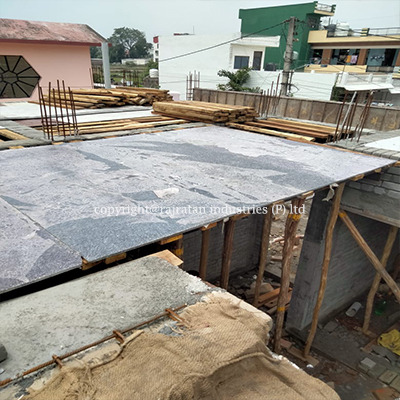
If you’re working on a construction project and wondering how to fix shuttering boards for slab work, you’ve landed in the right place. Whether you’re a contractor, site supervisor, or a builder managing your own project, getting the shuttering right is the foundation of a perfect concrete slab. In this guide, we’ll walk you through everything from choosing the right shuttering board to fixing it correctly for slab applications so your pour comes out smooth, strong, and flawless every time.
What Is a Shuttering Board and Why Does It Matter for Slab Work?
A shuttering board is a temporary formwork panel used in concrete construction to hold wet concrete in shape until it sets and gains sufficient strength. For slab work specifically, shuttering boards are laid horizontally on a support structure to form the base mould for the concrete pour.
The quality of your shuttering board directly impacts the quality of your finished slab. A poor-quality or improperly fixed board leads to concrete leakage, uneven surfaces, slab deflection, and costly rework. That’s why choosing the right material and fixing it correctly is absolutely critical.
Traditional options like plywood, steel, and PVC have long been used in formwork. However, modern composite alternatives such as the PAC® Shuttering Board by Rajratan Industries are rapidly replacing them due to superior performance, longer service life, and eco-friendly composition.
Choosing the Right Shuttering Board for Slab Work
Before you even think about fixing, you need to select the right shuttering board. Here’s what to look for:
Material Strength and Composition
For slab work, your board needs to handle significant compressive loads. The PAC® board, for instance, is manufactured using a composite mix of Industrial Grade Plastics (PP, LDPE, HDPE), Aluminium Oxide, Fibre, and Cross Linked Polymers (XLP) Metal — a combination that provides exceptional strength and dimensional stability under pressure.
Thickness
For standard slab formwork, boards are typically available in 12 mm and 18 mm thickness. The 18 mm variant is generally preferred for slabs due to the higher load-bearing requirements. Always match the thickness to the span between your supporting joists.
Size
Standard sizes available include:
- 2133 x 915 mm (7.00 x 3.00 Feet)
- 2438 x 915 mm (8.00 x 3.00 Feet)
- 2440 x 1220 mm (8.00 x 4.00 Feet)
Choose the size that minimizes joints across your slab, as fewer joints mean a smoother concrete surface and less risk of leakage.
Repetition Count
One of the biggest advantages of a quality shuttering board is its reusability. PAC® Premium boards offer 60+ repetitions, while the Standard series offers 30–40 repetitions. Compare this to ordinary plywood which lasts only up to 12 uses — and the economics become very clear.
Tools and Materials You’ll Need
Before starting, gather the following:
- PAC® Shuttering boards (12mm or 18mm as required)
- Wooden or steel props/adjustable supports
- Wooden joists or steel runners
- Screws (for wooden scaffolding) or rivets (for steel frame shuttering)
- Forming oil / release agent
- Spirit level
- Measuring tape and chalk line
- Hammer and screwdriver/drill
Step-by-Step: How to Fix Shuttering Boards for Slab Work
Step 1: Set Up the Prop and Support Structure
Begin by erecting vertical props (wooden or telescopic steel props) at regular intervals — typically every 900mm to 1200mm depending on slab thickness and load. Ensure all props are perfectly plumb using a spirit level.
Place horizontal runners (wooden joists or steel channels) across the tops of the props. These will directly support the shuttering board from below. Make sure the runners are level across the entire slab area — any unevenness here will result in an uneven slab soffit.
Tip: According to PAC® installation guidelines, provide additional support as per structural requirement to ensure the board is properly backed at all contact points.
Step 2: Apply Forming Oil to the Shuttering Board
Before placing the shuttering board, apply a thin, even coat of forming oil (release agent) on the face that will be in contact with concrete. This is one of the most important — and most overlooked — steps in slab shuttering.
Forming oil serves two critical purposes:
- It ensures the concrete does not bond with the board surface, making de-shuttering easy.
- It extends the service life of your board, allowing more repetitions.
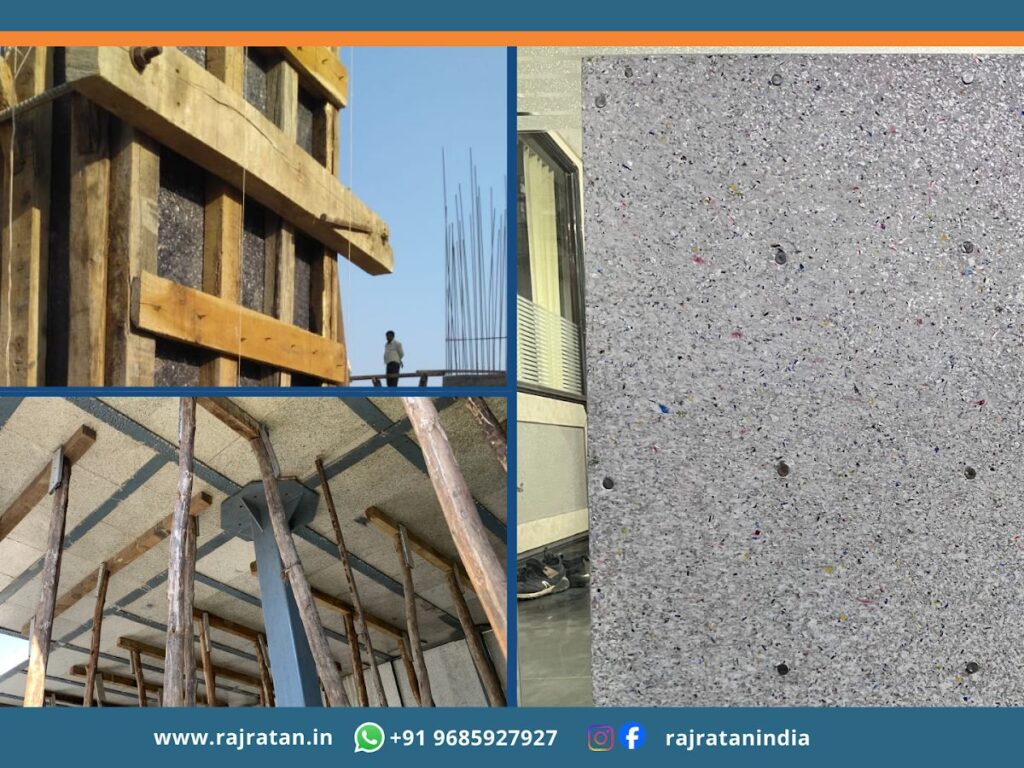
PAC® boards, with their smooth and matt dual-face finish, work exceptionally well with forming oil, delivering a clean concrete surface after every pour.
Step 3: Lay and Fix the Shuttering Boards
Place the oiled shuttering boards face-down on the joist runners. Lay them in a systematic pattern, starting from one end of the slab and working across. Stagger the joints — do not align all board ends on the same joist line, as this creates weak points.
For wooden scaffolding: Use screws to fix the boards to the joists. Drill the screws at the board edges and at mid-span if needed. Avoid over-tightening as it can cause surface damage.
For steel frame shuttering: As per PAC® guidelines, steel frames should be welded, and rivets should be used to fix the board to the frame. This creates a robust, rigid panel that can be reused many times without losing dimensional accuracy.
Ensure all board edges are tightly butted together. Any gaps between boards will result in concrete fins or leakage, which increases finishing work later.
Step 4: Check Levels and Alignment
Once all boards are fixed, use a long spirit level or a laser level to check the entire shuttering surface. Check in multiple directions — both along and across the slab. Any low or high spots must be corrected by adjusting the props beneath.
Double-check that the perimeter edge shuttering (side forms) is also correctly fixed and sealed to prevent concrete from flowing out at the edges.
Step 5: Inspect Before the Pour
Do a final walkover inspection before concreting begins:
- Are all props stable and plumb?
- Are all board joints tight?
- Is the forming oil applied evenly?
- Are the edge forms secure?
A few minutes of inspection before the pour can save hours of remedial work after.
After the Pour: De-Shuttering and Board Care
Once the concrete has gained adequate strength (typically 7–14 days for slabs, subject to structural engineer’s guidance), de-shuttering can begin.
Important: Avoid sudden drops or impacts to the board corners during de-shuttering. PAC® specifically recommends avoiding sudden falls from corners of the board at the time of de-shuttering to extend service life and repetitions.
After removal:
- Clean the boards thoroughly with water to remove all concrete particles.
- Stack them properly on a level surface.
- Re-apply forming oil before the next use.
This simple maintenance routine is what enables a shuttering board like PAC® to achieve 60–100+ repetitions, making it one of the most cost-effective formwork choices on the market.
Why PAC® Shuttering Board Outperforms Plywood for Slab Work
|
Feature |
Plywood |
PAC® Shuttering Board |
|---|---|---|
|
Water & Decay Proof |
No |
Yes |
|
Rust Resistant |
Yes |
Yes |
|
Number of Repetitions |
Up to 12 |
Up to 100 |
|
Eco-Friendly |
No |
Yes |
|
Sun / Heat Proof |
Limited |
High Level |
|
Buyback Option |
No |
Yes (40% buy-back) |
Additionally, PAC® boards are free of Lead, Arsenic, and Mercury, and are resistant to boiler water, acid, acetone solvent, alkali, and benzene solvent — making them safe and durable in demanding site conditions.
Final Thoughts
Knowing how to fix shuttering boards for slab work correctly can make the difference between a flawless concrete finish and an expensive rework. The process starts with selecting a high-quality shuttering board, setting up a solid support structure, applying forming oil, fixing the boards securely, and maintaining them well after each use.
If you’re looking for a reliable, eco-friendly, and cost-effective shuttering board for your next slab project, the PAC® Ecoprime Series by Rajratan Industries Private Limited is an excellent choice engineered for higher repetitions, smooth surface finish, and long-term economic value.
Don’t Choose Based on Price Alone
6 mm might look cheaper. But if it bends mid-pour, your labour cost, finish repairs, and time loss will erase the savings.
16 mm where 8 mm would work? That’s just dead weight and wasted cost.
Choose Based on Your Site Conditions
Ask yourself:
- Are you pouring wide slabs or tight verticals?
- Are you using mechanical vibration?
- How many repetitions do you expect?
- Is surface finish a top priority?
Final Word: Choose Smart, Not Just Cheap
Don’t guess. Don’t waste.
Choose based on load, finish, and repetition — not just price per sheet.
|
Still not sure what thickness is right for your job? |
|
Book a consultancy call; we’ll guide you based on your site load, repetition needs, and budget. Contact us at – 91+ 9685727927 |
👉 Explore PAC® Shuttering Sheet Options →
Why PAC®? Because every thickness we offer is designed around what actually happens on site not just what looks good on paper.
Lorem ipsum dolor sit amet, consectetur adipiscing elit. Ut elit tellus, luctus nec ullamcorper mattis, pulvinar dapibus leo.