Achieving Fair-Faced Exposed Concrete Finishes with PAC® Plastic Shuttering Boards
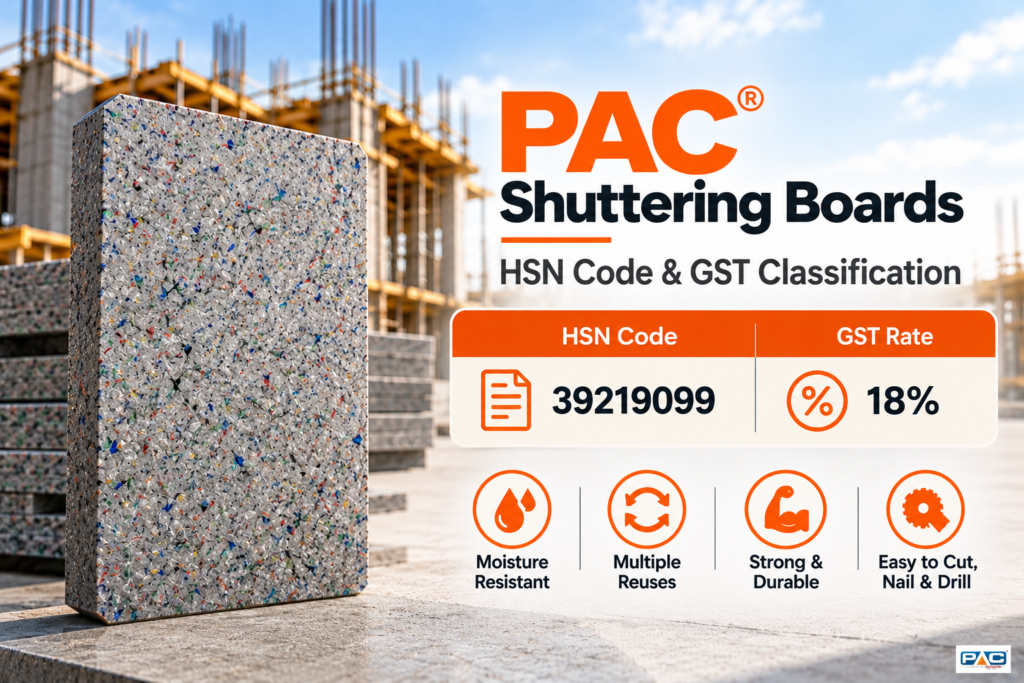
Fair-faced concrete demands perfection. A single water stain, surface bloating, or efflorescence ruins aesthetics and triggers costly secondary plastering. PAC® Plastic Shuttering Boards eliminate these defects at their source: zero water absorption, certified compressive strength (22.0 N/mm²), and rigid PVC composite geometry that survives 50+ consecutive pours without warping, swelling, or structural degradation.
The Architectural Quality Problem: Why Timber Shuttering Fails Fair-Faced Finishes
Conventional timber shuttering absorbs moisture and swells unpredictably. Over 8–12 reuses, boards warp, split, and lose surface planarity. Water-induced bloating transfers directly to the concrete surface, creating a mottled, aesthetically compromised finish. Architects then specify costly rework—grinding, patching, or complete plastering—adding 2–3 weeks to project schedules and ₹150–₹300/sq.ft. in hidden costs.
PAC® boards solve this through engineered material science. Reinforced PVC composite + aluminum oxide + metal dust yields a density of 1135 kg/m³ and compressive strength of 22.0 N/mm² (tested per IS 1734). Result: flawless mold geometry across 50+ pours, zero surface bloating, and architectural-grade concrete finishes.
Technical Superiority: The Materials Behind Fair-Faced Precision
| Property | PAC® Shuttering Board | Conventional Timber | Competitive Plastic |
|---|---|---|---|
| Water Absorption | 0% (no swelling) | 15–25% (progressive warping) | 2–5% (dimensional instability) |
| Compressive Strength | 22.0 N/mm² | 8–12 N/mm² (variable) | 12–16 N/mm² (uncertified) |
| Density | 1135 kg/m³ | 600–800 kg/m³ | 900–1050 kg/m³ |
| Reuse Cycles | 50–60+ | 8–12 | 20–30 (accelerated degradation) |
| Surface Finish | Mirror polish, zero bloating | Bloat-prone, moisture stains | Inconsistent surface texture |
| Workability (Nail/Screw) | Identical to timber | Baseline | Brittle, prone to splitting |
Cost-Per-Cycle Economics: 65% Savings vs. Timber
PAC® Shuttering Board pricing (₹80–₹90/sq.ft. base, ₹125/sq.ft. for 18mm column boards) achieves dramatic unit-economics through reuse cycles and buyback value:
- Timber shuttering: ₹50–₹60/sq.ft. base price × 8–12 uses = ₹5–₹7.50/sq.ft. per use
- PAC® shuttering (Standard): ₹80/sq.ft. × 50 uses + 40% buyback = ₹1.60/sq.ft. per use
- PAC® shuttering (Premium Black): ₹90/sq.ft. × 60 uses + 40% buyback = ₹1.50/sq.ft. per use
Savings per high-rise project (120+ pours, 100,000 sq.ft. formwork): ₹65 lakhs reduction in total formwork cost. Buyback recovery alone nets ₹6–₹8 lakhs.
Compliance & Durability: Specifiable for Architects & Engineers
PAC® boards meet rigorous certification standards:
- NABL Lab Tested (Choksi & STEDRANT): Compressive strength 22.0 N/mm², density 1135 kg/m³, moisture content 0.33–0.64%, static load capacity 7,500 kg
- IS 1734 Compliance: Water swelling test (Part 6): 0% absorption; nail holding power (Part 19): 2,214–2,460 N; fire resistance (Part 3): passed
- Full Specification Document: Architects and structural engineers can reference lab test reports directly in tender documents
Objection Handling: Water Resistance, Workability & Pricing Transparency
Objection 1: “Won’t water absorption cause bloating in repetitive wet cycles?”
Response: Zero water absorption (0% per IS 1734 Part 6). Tested in boiling-water submersion for 24 hours—no swelling, no delamination. Unlike timber (15–25% absorption), PAC® maintains dimensional stability across infinite cycles.
Objection 2: “Plastic boards won’t accept nails/screws like timber.”
Response: Nail holding power of 2,214–2,460 N (ISO 1734 Part 19) is identical to timber. Metal dust reinforcement prevents splitting. You can nail, screw, and cut exactly as with plywood—zero labor friction for formwork contractors.
Objection 3: “Pricing seems high—what’s the real ROI?”
ROI calculator:
Base cost ₹80/sq.ft. ÷ 50 uses = ₹1.60/sq.ft. per pour. Timber at ₹55/sq.ft. ÷ 10 uses = ₹5.50/sq.ft. per pour. Payback occurs after 15–18 pours; thereafter pure margin. Add 40% buyback, and effective acquisition cost drops to 60% on next order.
Case Study: High-Rise Residential, Fair-Faced Specification, 120+ Pours
Project Profile: 25-storey residential complex, Mumbai. Structural engineer specified fair-faced concrete finish (zero secondary plastering). 100,000 sq.ft. total formwork.
Timber baseline (competitor analysis): ₹55/sq.ft. × 10 uses = ₹550,000 per pour × 120 pours = ₹6.6 crores formwork cost. Bloating defects required 2–3 weeks rework on 40 floors (₹1.2 crores additional grinding/patching).
PAC® implementation: ₹80/sq.ft. base × 50 uses + buyback recovery = ₹1.6/sq.ft. per use × 120 pours = ₹1.92 crores formwork cost. PLUS: Zero bloating → Zero rework → On-time handover. Savings: ₹4.68 crores (65% reduction). Project completed 18 days early, enabling early revenue recognition.
Why Architects & Engineers Specify PAC®
Precision: Certified geometry ensures consistent mold reproduction—no re-troweling, no cover-up finishes.
Compliance: NABL-tested data is directly citable in technical specifications. No ambiguity; auditable.
Economics: 40% buyback credit transforms capex into operating margin. CFOs model it as recurring formwork cost (₹1.60–₹1.80/sq.ft./use) rather than consumable waste.
Sustainability: 100% recycled industrial packaging waste + infinite reuses = auditable ESG impact for green-certified projects.
Technical Specifications & Pricing
| Product | Thickness | Density | Compressive Strength | Reuse Cycles | Price (Base) |
|---|---|---|---|---|---|
| EcoPrime Standard White | 12mm | 1130 kg/m³ | 22.0 N/mm² | 40–50 | ₹80/sq.ft. |
| EcoPrime Premium Black | 12mm | 1150 kg/m³ | 22.0 N/mm² | 60+ | ₹90/sq.ft. |
| Column Formwork Board | 18mm | 1135 kg/m³ | 22.0 N/mm² | 50+ | ₹125/sq.ft. |
Bulk Discounts: 10% off at 200+ sheet orders. Buyback Credit: 40% scrap value recovery on return. Logistics: TCI/VRL/Safexpress delivery from Indore. Payment Terms: 30% advance, 70% against LR/Bilty.
Conclusion
For high-rise projects, shuttering costs are driven by more than the initial board price. Reuse, reduced maintenance, lower replacement needs and labour efficiency all impact the overall formwork cost.
PAC® Shuttering Boards offer a reusable alternative to timber formwork, with 60–100+ reuse potential, moisture resistance and a 40% buyback program. This can help contractors reduce recurring formwork expenses and improve project efficiency.
In short: More Reuses. Less Rework. Lower Cost per Use.