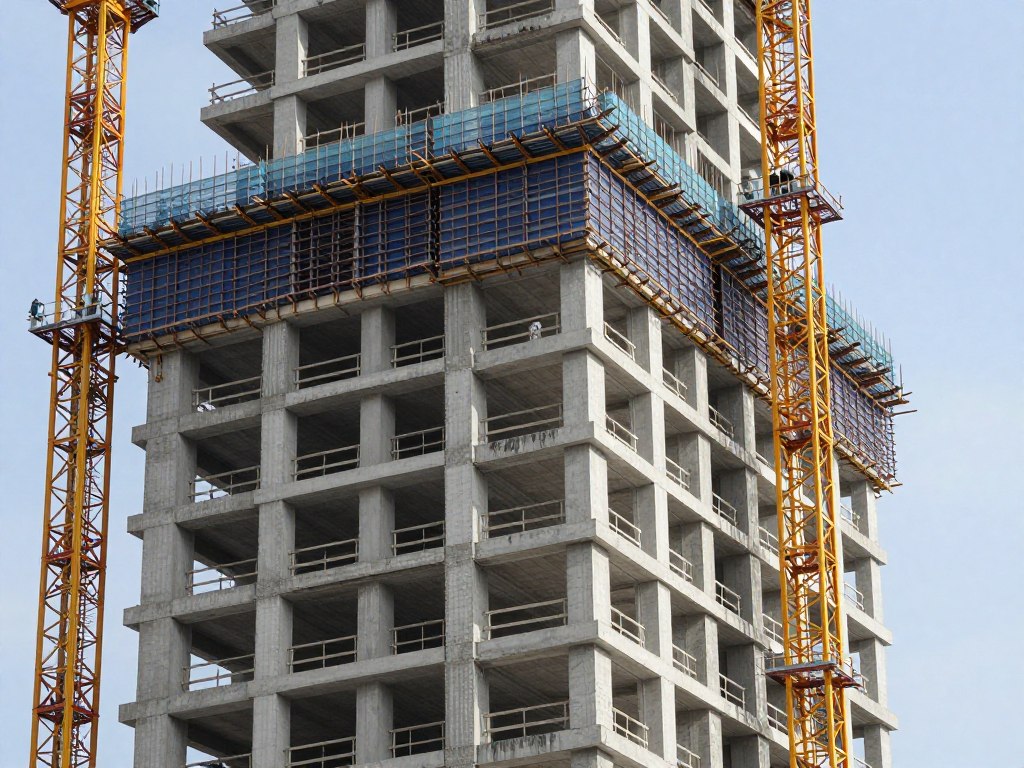
Choosing the right formwork material is an important decision for contractors, builders, and project engineers. The material you use for slabs, beams, columns, and other concrete structures affects not only the quality of the finished surface but also labour requirements, reuse cycles, maintenance, and overall project cost.
For decades, plywood has been one of the most commonly used materials for concrete formwork. It is easy to cut, nail, and install, making it familiar to construction teams. However, repeated exposure to moisture, cement slurry, handling, and de-shuttering can gradually affect its performance.
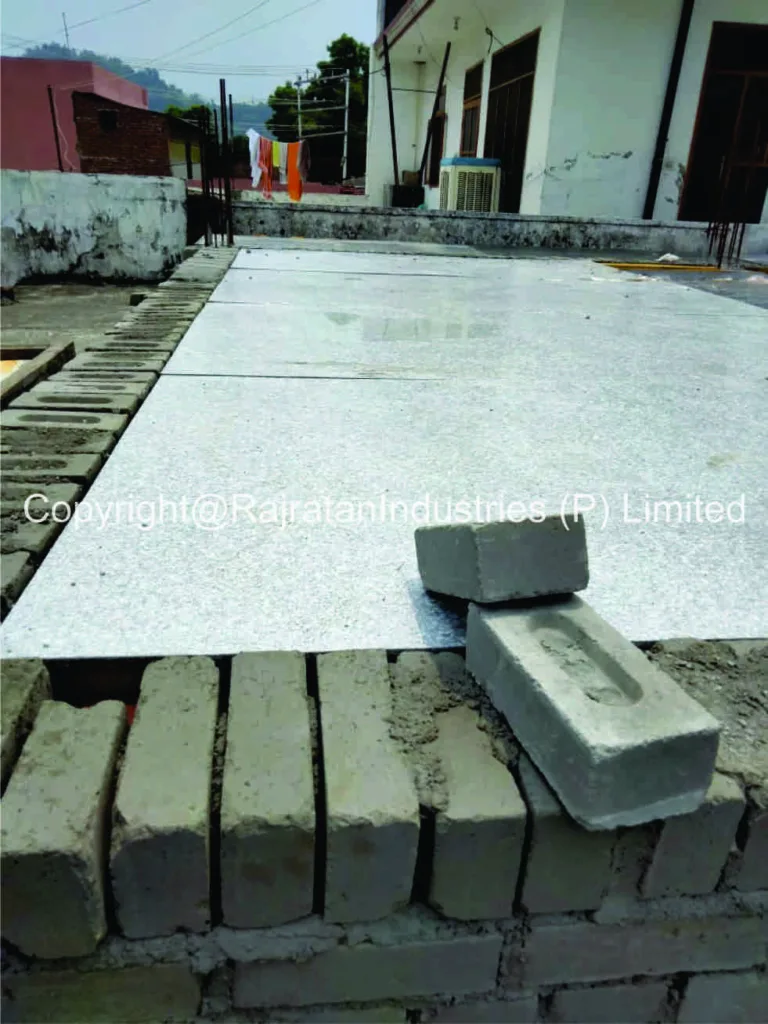
Today, contractors have another option: PAC® Shuttering Board, a plastic-aluminium composite formwork board designed for repeated use in concrete construction.
So, how does PAC® Shuttering Board compare with traditional plywood?
Let’s look at the differences in terms of durability, handling, reuse, maintenance, and cost per use.
What Is a PAC® Shuttering Board?
PAC® stands for Plastic Aluminium Composite.
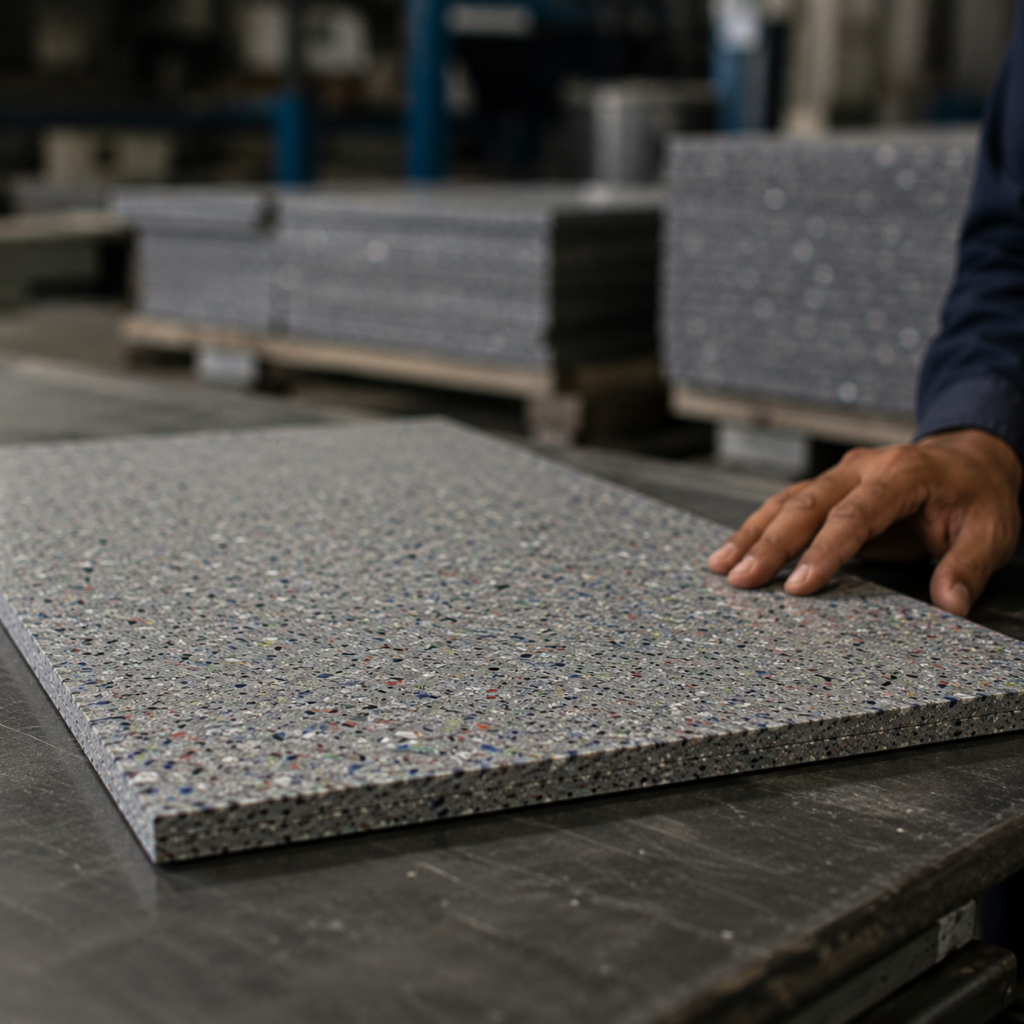
A PAC® Shuttering Board is a dense composite formwork sheet manufactured using plastic-based materials reinforced with aluminium oxide, fibres, and XLP metals. The material is designed specifically for applications where moisture resistance, durability, and repeated use are important.
Unlike conventional wood-based shuttering materials, PAC® boards do not depend on wood fibres for their structure. This makes them resistant to common moisture-related problems such as swelling, warping, and delamination.
The boards can also be cut, drilled, nailed, and screwed using commonly available carpentry tools, making them practical for construction sites where workers are already familiar with conventional shuttering methods.
Rajratan manufactures PAC® Shuttering Boards at its facility in Indore, Madhya Pradesh, with different grades available for different construction requirements.
PAC® Shuttering Board vs Plywood: A Direct Comparison
The biggest difference between the two materials becomes clear when they are evaluated over multiple concrete casting cycles.
Plywood can provide good performance when properly selected and maintained, but its service life is influenced significantly by moisture, handling, edge damage, and the number of times it is reused.
PAC® Shuttering Board is designed specifically for repeated use and moisture-resistant performance.
|
Feature |
PAC® Shuttering Board |
Traditional Waterproof Plywood |
|
Material |
Plastic Aluminium Composite (PAC®) |
Wood veneers with adhesive layers |
|
Moisture Resistance |
Highly water-resistant |
Can absorb moisture and may swell or delaminate |
|
Expected Repetitions |
Approximately 30–100+ depending on grade and usage |
Typically around 5–10, depending on plywood quality and handling |
|
Surface Finish |
Smooth and consistent |
Depends on plywood condition and surface quality |
|
Shuttering Oil |
Light application generally sufficient |
Regular oiling generally required |
|
Cutting & Nailing |
Can be cut, drilled, nailed and screwed |
Can be cut, drilled, nailed and screwed |
|
Chemical / Cement Exposure |
Designed for resistance to common construction-site exposure |
Wood layers can deteriorate with prolonged exposure |
|
End-of-Life Value |
40% buyback program, subject to applicable terms |
Generally limited residual value |
|
Available Sizes |
8×4 ft, 8×3 ft, 7×3 ft |
Commonly available in 8×4 ft |
|
Thickness Options |
12mm and 18mm |
12mm and 18mm |
The exact number of repetitions depends on the board grade, support arrangement, installation practices, handling, cleaning, and site conditions.
Why Cost Per Use Matters More Than Purchase Price
One of the most important factors when comparing shuttering materials is the cost per repetition.
A PAC® Shuttering Board has a higher initial purchase price than standard plywood. However, if the board can be reused significantly more times, the effective cost for each concrete pour can be lower.
Let’s look at an example.
Example: Plywood
Based on the figures provided:
- Approximate 12mm plywood price: ₹45 per sq. ft.
- 8×4 ft sheet area: 32 sq. ft.
- Approximate cost per sheet: ₹1,440
- Example reuse: 6 runs
- Approximate cost per run: ₹240 per sheet
This means the initial purchase price is lower, but the material needs to be replaced more frequently.
Example: PAC® ECOPRIME Standard
Using the stated product figures:
- 12mm ECOPRIME Standard: ₹80 per sq. ft.
- 8×4 ft sheet area: 32 sq. ft.
- Approximate cost per sheet: ₹2,560
- Example reuse: 35 runs
- Approximate cost per run before buyback: ₹73 per sheet
Under the applicable 40% buyback program:
- Example buyback value: ₹1,024
- Effective material cost: ₹1,536
- Approximate effective cost per run: ₹43.80 per sheet
This illustrates why evaluating shuttering material based only on the initial purchase price does not provide the complete picture.
For large projects, cost per repetition and total lifecycle cost can be much more useful metrics.
PAC® Shuttering Board Grades
Rajratan offers different PAC® Shuttering Board grades to suit different project requirements.
1. ECOPRIME Standard — Marble White
ECOPRIME Standard is a 12mm PAC® Shuttering Board designed for regular construction applications.
Key Specifications
- Composition: 60% Mix Plastic, 25% Aluminium Oxide, 15% XLP Metals
- Density: Approximately 1100 kg/m³
- Approx. weight: 40 kg per 8×4 ft sheet
- Expected repetitions: 30–40 runs
- Price: Approximately ₹80 per sq. ft.
- Recommended applications: Residential slabs, beams, columns, and low-rise construction
It is a practical option for projects where moderate reuse and easy site handling are the primary requirements.
2. ECOPRIME Premium — Marble Black
ECOPRIME Premium is designed for projects that require higher reuse and greater board density.
Key Specifications
- Composition: 52% Mix Plastic, 23% Aluminium Oxide, 25% XLP Metals
- Density: Approximately 1320 kg/m³
- Approx. weight: 45 kg per 8×4 ft sheet
- Expected repetitions: 60+ runs, with 100+ possible under suitable site conditions
- Price: Approximately ₹90 per sq. ft.
- Recommended applications: High-rise buildings, commercial construction, columns, and infrastructure projects
The higher density and material composition are intended to provide greater stiffness and durability for demanding applications.
3. 18mm Heavy-Duty PAC® Shuttering Board
For applications where additional thickness and stiffness are required, Rajratan also offers an 18mm heavy-duty shuttering board.
Key Details
- Thickness: 18mm
- Price: Approximately ₹125 per sq. ft.
- Recommended applications: Heavy RCC work, retaining walls, bridge piers, and thick industrial slabs
The appropriate board thickness should always be selected according to the formwork design, support system, concrete pressure, and structural requirements of the project.
How PAC® Shuttering Board Performs on Site
One of the biggest questions contractors have when switching from plywood is simple:
Can my carpenters work with it in the same way they work with plywood?
In most routine applications, the answer is yes.
Cutting
PAC® boards can be cut using commonly available hand saws or circular power saws.
The board is designed to provide clean cuts without the typical splintering associated with wood-based materials.
Nailing and Screwing
The boards can be nailed and screwed using standard site tools.
Proper edge distance should be maintained during installation to reduce the risk of damage.
Nail Holes
Because PAC® is a solid composite material rather than a layered wood product, moisture entering through nail holes does not create the same swelling and delamination issues associated with plywood.
Shuttering Oil
PAC® boards have a non-porous surface, so they generally require only a light application of suitable shuttering oil to assist with concrete release.
This can reduce the amount of release agent required compared with porous wood-based formwork materials.
PAC® Shuttering Board for Repeated Construction Cycles
The main advantage of a reusable shuttering system is not simply that the material lasts longer.
It is that the same board can potentially be used across multiple casting cycles.
This can help contractors reduce:
- Frequent material replacement
- Formwork material wastage
- Procurement frequency
- Handling of damaged boards
- Long-term material costs
However, reuse should always be evaluated under actual project conditions. Proper support, alignment, cleaning, storage, handling, and de-shuttering practices are essential for achieving the expected number of repetitions.
40% Buyback Program
Another important part of Rajratan’s PAC® Shuttering Board offering is the 40% buyback program.
Under the applicable program, used PAC® boards can be returned after their service life and the eligible buyback value can be adjusted against a new purchase.
This provides contractors with an additional recovery value at the end of the board’s usable life.
It also supports a more circular approach to construction materials by creating a defined route for used boards to return into the material recovery system.
Customers should confirm the latest buyback eligibility, valuation method, and applicable terms before purchase.
Which Is Better: PAC® Shuttering Board or Plywood?
The answer depends on your project.
Choose plywood when:
- The project requires only limited reuse.
- Initial purchase cost is the primary consideration.
- Your team already has an established plywood-based formwork system.
- The expected number of casting cycles is relatively low.
Consider PAC® Shuttering Board when:
- You need repeated reuse.
- Moisture resistance is important.
- You want to reduce replacement frequency.
- You want to calculate formwork cost based on cost per repetition.
- Your project involves multiple slabs, columns, or casting cycles.
- You want an end-of-life buyback option.
For high-repetition projects, the higher initial price of PAC® can potentially be offset by its longer reuse cycle.
Start With a Trial Order
If your team has never used PAC® Shuttering Board before, a trial order is a practical way to evaluate the material before making a larger investment.
Rajratan recommends starting with approximately 5–10 sheets.
A trial allows your site team to evaluate:
- Cutting
- Nailing
- Screwing
- Handling
- Concrete release
- Surface finish
- Cleaning
- Repetition performance
Once the material has been tested under actual site conditions, you can decide whether Standard, Premium, or the 18mm grade is appropriate for your project.
Ordering, Payment and Logistics
Rajratan manufactures PAC® Shuttering Boards at its Indore facility and supplies them to customers across India.
Payment
The stated payment structure is:
- 30% advance payment
- 70% balance before dispatch
COD is not available for these heavy industrial materials because dispatch is handled through third-party transport services.
Transportation
Products are shipped through logistics partners, with transportation charges generally paid separately to the transporter.
Small trial orders may be delivered to the transporter’s nearest godown, while larger orders can be arranged for direct site delivery depending on the location and logistics arrangement.
Customers should confirm current pricing, stock availability, freight charges, payment terms, and delivery conditions before placing an order.
Frequently Asked Questions
Is PAC® Shuttering Board waterproof?
PAC® Shuttering Board is designed to be highly water-resistant and does not have the wood-fibre layers found in plywood. This helps prevent common moisture-related problems such as swelling and warping.
Can PAC® Shuttering Board be cut and nailed like plywood?
Yes. It can be cut, drilled, nailed, and screwed using commonly available carpentry tools.
How many times can PAC® Shuttering Board be reused?
The expected number of repetitions depends on the grade and site conditions.
- ECOPRIME Standard: approximately 30–40 runs
- ECOPRIME Premium: 60+ runs, with 100+ possible under suitable conditions
- 18mm Heavy-Duty: designed for heavy-duty applications
Actual performance can vary depending on handling, support, cleaning, alignment, and installation practices.
Does PAC® Shuttering Board require shuttering oil?
A light application of suitable shuttering oil is generally sufficient to assist with concrete release.
How does the 40% buyback program work?
Under the applicable buyback program, eligible used PAC® boards can be returned and the applicable value can be adjusted against the purchase of new boards. Confirm the current terms and valuation method with Rajratan before ordering.
Final Takeaway
When comparing PAC® Shuttering Board vs plywood, the right question is not simply:
“Which one is cheaper per sheet?”
The better question is:
“Which material gives me the lower cost over the complete project?”
Plywood offers a familiar and widely used formwork solution, particularly for projects with limited reuse requirements.
PAC® Shuttering Board, on the other hand, is designed around reusability, moisture resistance, durability, and lifecycle value. For projects involving repeated concrete casting cycles, these factors can make a significant difference to the overall economics of formwork.
The best choice ultimately depends on your project size, number of repetitions, site conditions, formwork design, and budget.
Looking for the right PAC® Shuttering Board for your project?
Contact Rajratan Industries to discuss your project requirements, arrange a trial order, or request a quotation.
Rajratan Industries Private Limited
Indore, Madhya Pradesh, India
Phone: +91 9685727927
Email: info@rajratan.in
Website: shutteringboard.rajratan.in