
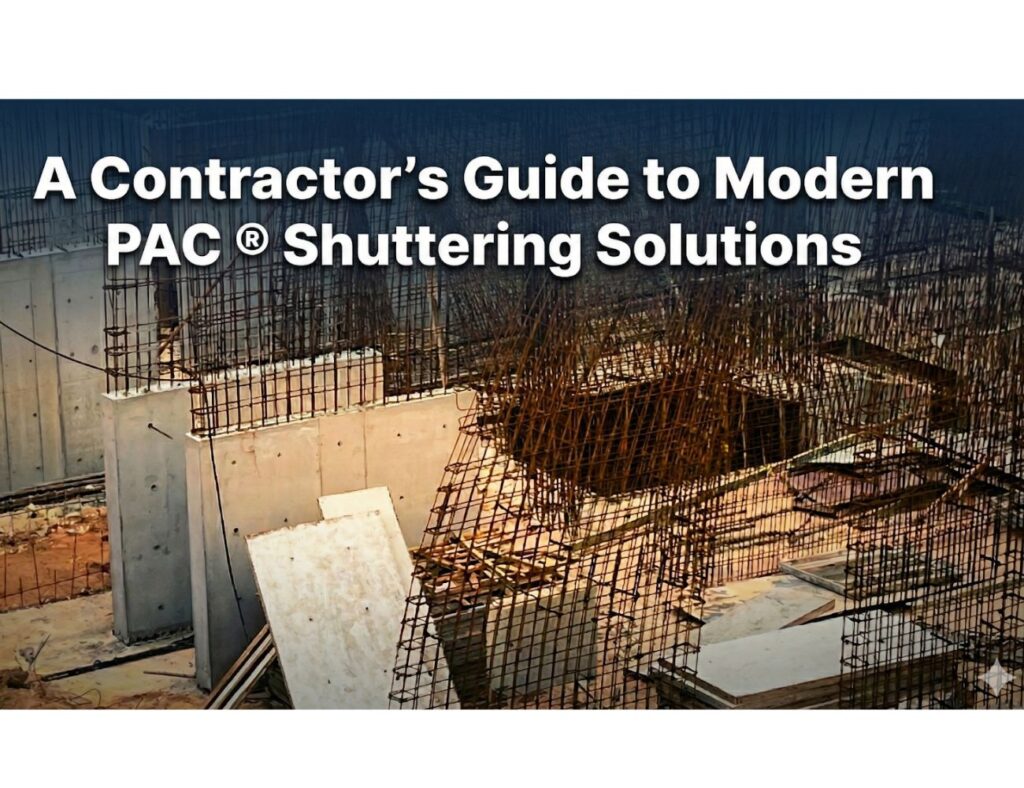
For decades, shuttering plywood has been the default choice on Indian construction sites. It’s familiar, inexpensive upfront, and easy to source. But with rising project timelines, tighter quality expectations, and unpredictable weather cycles, contractors are increasingly finding plywood to be the weakest link in the formwork chain.
Two forces create the biggest problems: moisture and termites. And both attack plywood long before the project is complete.
1. Moisture: The Silent Reason Ply Fails Early
Indian construction doesn’t pause for weather — and plywood pays the price.
What moisture actually does to shuttering ply:
- Swelling & warping: Even “waterproof” ply begins absorbing humidity from curing concrete, rain, or wet site conditions.
- De-lamination: Layers start to peel, especially around corners and edges.
- Uneven concrete finish: A swollen board leaves wavy marks or patchy textures.
- Shorter lifespan: Even premium ply rarely crosses 8–12 repetitions in real field conditions.
Moisture damage isn’t gradual — it can alter the board within the first few cycles, leading to poor finish and frequent replacements.
2. How Physical Mishandling Damages Traditional Shuttering Ply
Plywood is a natural, layered material. It cannot tolerate the kind of rough usage that typically happens on Indian sites. Over time, this physical stress breaks down the layers and weakens the board long before it should.
Here’s how mishandling causes damage:
1. Dropping and Dragging the Sheets
When workers drag sheets on concrete floors, drop them from trucks, or knock them against columns and beams, the edges chip easily.
Once the edge breaks, the laminated layers begin to open up, leading to swelling and faster deterioration.
2. Hammering and Forced Removal
During de-shuttering, plywood is often pried open using metal rods, hammers, and crowbars.The impact breaks the corners, loosens the layers, and creates cracks that grow with every reuse.
3. Heavy Loading and Uneven Pressure
Wet concrete is extremely heavy. When weight is unevenly distributed especially on weak or old plywood — it causes bending and long-term loss of stiffness.
Once the board loses its flatness, slab surface finish quality drops immediately.
4. Stacking and Storage Issues
If plywood is stored in open sunlight, in wet areas, or stacked under heavy loads, the sheets warp.Bent plywood cannot return to its original shape and becomes unusable for accurate shuttering.
Why PAC® Shuttering Boards are Becoming the Preferred Solution?
PAC® Shuttering Boards engineered from Industrial Grade Plastics, Aluminium Oxide, Fibres, and XLP Metals solve the two biggest failure points of plywood by design.
They are built to perform in India’s toughest weather and heaviest casting environments.
What Makes PAC® Boards Different?
Zero Water Absorption
PAC® boards do not swell, bubble, delaminate, or lose shape — even in monsoon casting or heavy curing cycles.
Consistent, Smooth Concrete Finish
The non-porous, engineered surface creates a clean, fair-faced finish without patchwork or grain marks.
60–100+ Repetitions in Real Site Conditions
Compared to plywood’s 10–12 cycles, PAC® delivers a drastically lower cost-per-use.
Heat & UV Resistant
PAC® boards maintain rigidity even in peak summer temperatures.
No Physical Mishandling
They do not chip, crack, or delaminate even when handled roughly.
Whether the board is dragged, knocked, or exposed to impact, the structure remains intact.
Circular Use with 40% Buyback Programme
PAC® boards are fully recyclable.
At end-of-life, Rajratan buys them back at 40% value, turning them into new utility products making it cost-effective and sustainable.
What Contractors Should Consider Before Switching.
If you’re evaluating alternatives to plywood, look for:
- Industrial-grade composite boards, not municipal-waste plastic.
- Uniform thickness and rigidity for accurate shuttering.
- Surface finish options (smooth, matt).
- Warranty or buyback programmes to offset costs.
Conclusion
Plywood fails because it is inherently vulnerable to moisture and termites.
PAC® Shuttering Boards succeed because they are engineered specifically to eliminate these vulnerabilities.
In a climate like India — where heat, humidity, and monsoon cycles never pause — PAC® boards offer contractors long-term reliability, lower lifecycle cost, and consistently better casting results.
- Phone: 0731 4045302
- Mobile: +91 96857 27927
- Email: info@rajratan.in
Get In Touch With Us!
Phone
info@rajratan.in
Address
123-124 First Floor, Shastri market Indore 452 007, M.P. India