


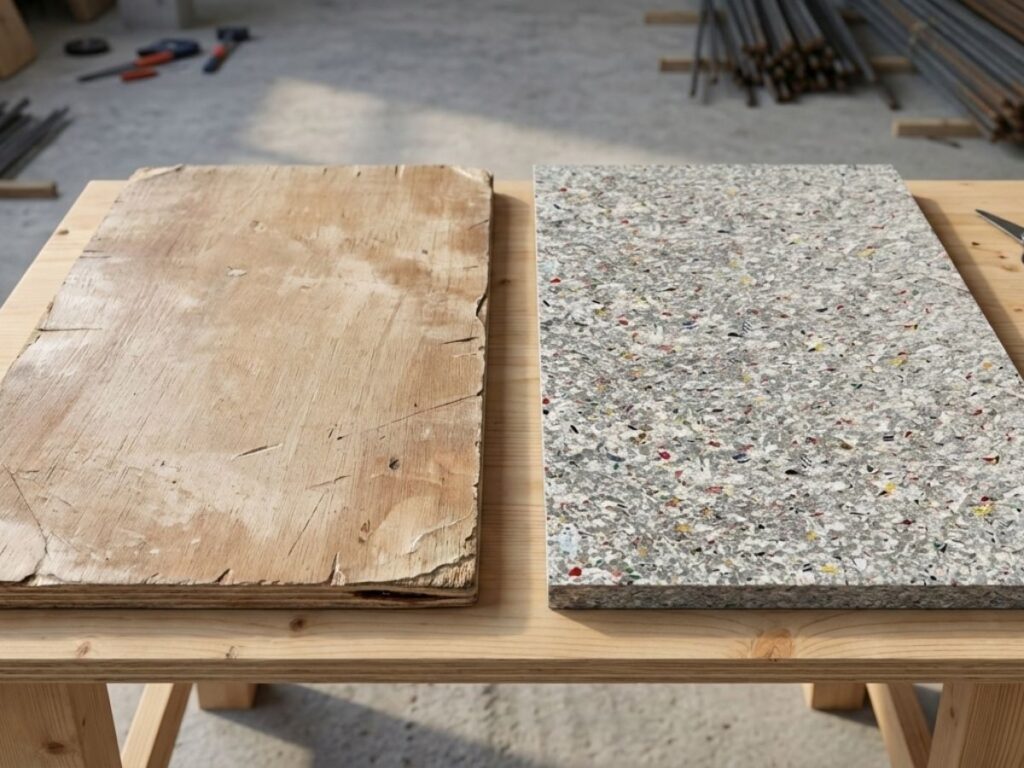
Across construction sites in India, plastic-coated plywood sheets are often positioned as an “improved” alternative to conventional shuttering ply. The logic sounds reasonable: add a plastic layer, protect the surface, extend the board’s life.
But in practice, surface coating solves only a fraction of the problems that cause shuttering boards to fail.
As construction cycles accelerate, monsoon casting becomes routine, and expectations for surface finish rise, contractors are discovering a hard truth: formwork performance is decided by what’s inside the board, not what’s applied on top.
This is where PAC® Shuttering Boards represent a fundamentally different approach.
What Plastic-Coated Plywood Actually Fixes — and What It Doesn’t
Plastic-coated plywood sheets are still, at their core, wood-based products. The coating primarily acts as a surface barrier, intended to:
- Reduce direct water contact
- Improve initial concrete finish
- Delay surface wear
However, the coating does not change the internal structure of plywood.
Once the board is cut, drilled, or used repeatedly, moisture begins to penetrate through edges and joints. Over time, this leads to:
- Swelling of inner layers
- Delamination between plies
- Loss of flatness
- Edge chipping and corner breakage
The coating remains intact in patches, but the board underneath continues to behave like wood.
Why Surface Protection Fails in Indian Site Conditions
Indian construction sites expose shuttering materials to a combination of stresses that surface coatings alone cannot handle:
- Repeated wet–dry cycles
- High ambient humidity
- Direct sun exposure
- Mechanical vibration and handling damage
Plastic-coated ply often performs acceptably in early repetitions. But as internal layers absorb moisture and soften, performance drops sharply. Contractors then see:
- Uneven slab levels
- Patchy concrete finish
- Increased oiling and maintenance
- Early board replacement
In most cases, boards fail from the inside out, even while the surface coating still looks intact.
PAC® Shuttering Boards: A Material-Level Solution
PAC® Shuttering Boards are not plywood with protection added. They are engineered composite boards, designed from the material level to eliminate the weaknesses of wood-based formwork.
Instead of timber layers, PAC® boards are manufactured using:
- Industrial-grade pre-consumer plastics (PP, LDPE, HDPE)
- Aluminium Oxide
- Fibres and XLP metals
These materials are processed under controlled heat and pressure to create a dense, uniform, non-porous structure throughout the board — not just on the surface.
The result is a board whose performance does not depend on coatings, laminates or surface films.
Structural Stability vs Surface Treatment
The critical difference between plastic-coated ply and PAC® boards lies in dimensional stability.
Plastic-coated plywood:
- May look smooth initially
- Gradually bends under load
- Loses flatness due to moisture ingress
- Requires frequent replacement
PAC® Shuttering Boards:
- Maintain flatness across hundreds of repetitions
- Do not swell, warp or delaminate
- Transfer load evenly during casting
- Deliver consistent slab and column geometry
Because the entire board is waterproof, not just the surface, performance remains predictable across seasons.
Concrete Finish: Consistency Over Time
Plastic-coated ply can deliver a good finish early on, but surface scratches, coating wear, and internal deformation soon compromise results. This often leads to:
- Visible lines
- Uneven textures
- Additional plastering work
PAC® boards feature a non-absorbent, smooth composite surface that does not chemically bond with concrete. This ensures:
- Clean release
- Uniform finish across repeated uses
- Reduced finishing labour
For projects where fair-faced concrete or consistent slab finish is important, this stability becomes a measurable advantage.
Service Life and Lifecycle Cost
A common reason plastic-coated plywood remains popular is lower upfront cost. But lifecycle analysis tells a different story.
Typical field performance:
- Plastic-coated plywood: 10–15 repetitions (often less in monsoon)
- PAC® Shuttering Boards: 80–100+ repetitions
When replacement frequency, downtime, labour handling, and waste disposal are considered, PAC® boards deliver a significantly lower cost per use, despite higher initial pricing.
Additionally, PAC® boards are supported by a 40% buyback replacement programme, ensuring residual value at end-of-life — something plywood cannot offer.
Sustainability: Coating vs Circular Design
Plastic-coated plywood is difficult to recycle. Once damaged, it typically ends up as landfill or low-grade waste.
PAC® Shuttering Boards are:
- Made from recyclable industrial plastics
- Designed for long service life
- Reprocessed into other utility products after use
This aligns with a circular material approach rather than a disposable one — an increasingly important consideration for large contractors and infrastructure projects.
Conclusion
Plastic coating improves plywood’s surface, but it does not change the nature of the material beneath. In demanding construction environments, that limitation becomes visible sooner than expected.
PAC® Shuttering Boards address formwork performance at the material engineering level, not as a surface fix. By eliminating moisture absorption, structural instability and premature degradation, they deliver consistency that surface-coated plywood cannot sustain.
For contractors evaluating formwork solutions beyond short-term cost, the choice is no longer about coatings — it’s about what the board is fundamentally made.
Know more about PAC® Shuttering Board – Shuttering Board
- Phone: 0731 4045302
- Mobile: +91 96857 27927
- Email: info@rajratan.in
Get In Touch With Us!
Phone
info@rajratan.in
Address
123-124 First Floor, Shastri market Indore 452 007, M.P. India

