


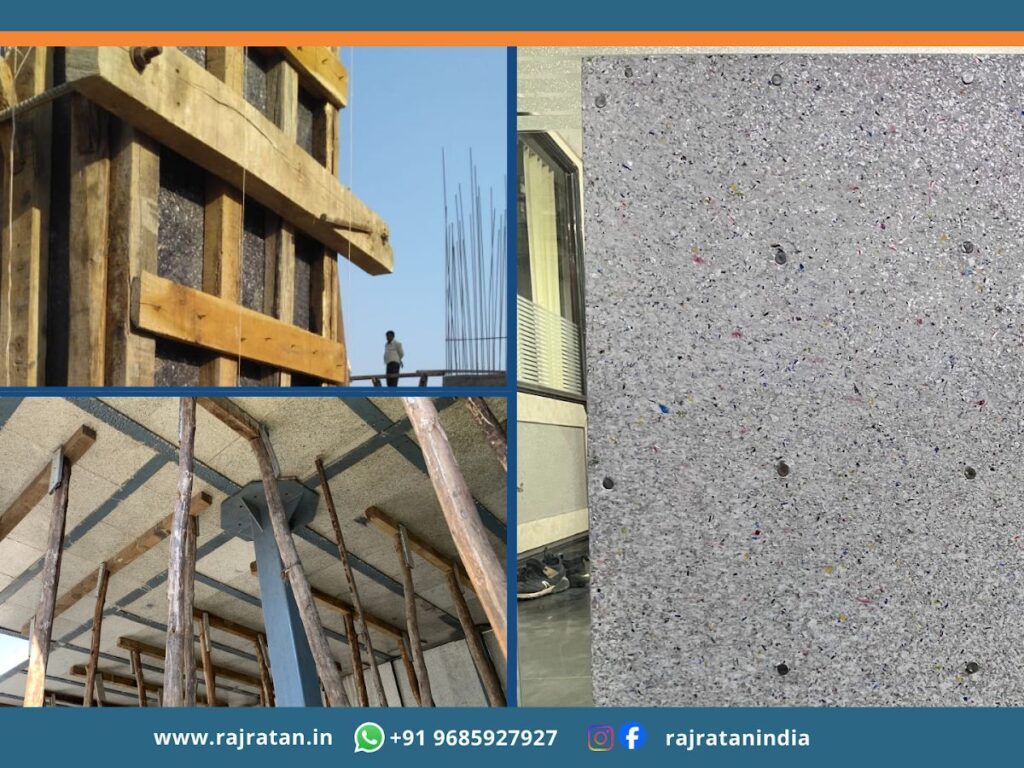
For decades, timber plywood has been the default choice for concrete formwork. It is familiar, easy to source, and simple to cut on site. But as construction projects demand faster turnaround, better surface finishes, and more sustainable practices, timber’s limitations are becoming harder to ignore. Plastic formwork systems, such as PAC (Plastic Aluminum Composite) boards, are increasingly replacing plywood, steel, and PVC sheets in the formwork industry. Here’s a detailed look at why this shift is happening and what it means for contractors, developers, and site engineers.
The Problem With Timber Formwork
Plywood has long been valued for its low upfront cost and workability. However, its performance degrades quickly under real site conditions. Timber absorbs water, which causes swelling, warping, and eventual delamination after just a handful of concrete pours. Most conventional plywood shuttering boards only deliver around 10-12 repetitions before they need to be discarded. This short lifespan means contractors must budget for frequent replacement, increasing both material costs and waste generation.
Timber is also vulnerable to fungal decay, termite damage, and UV degradation when stored or used outdoors over extended periods. Surface quality deteriorates with each use, leading to rougher concrete finishes that often require additional plastering or rework. From an environmental standpoint, timber-based formwork contributes directly to deforestation, and discarded plywood sheets typically end up as construction waste in landfills rather than being recycled.
What Makes Plastic Formwork Different
Plastic composite boards like PAC are manufactured from a blend of industrial-grade plastics (PP, LDPE, HDPE), aluminum oxide, fibre, and cross-linked polymer (XLP) metals. This composition is specifically engineered to overcome the weaknesses of timber while retaining the practicality contractors expect from a shuttering material. The result is a board that combines the strength and durability needed for repeated structural use with a smoother finish and a substantially longer service life.
1. Dramatically Higher Number of Repetitions
This is perhaps the single biggest advantage plastic formwork holds over timber. While plywood typically manages only about 12 reuses, PAC boards are rated for 30-40 repetitions in the Standard range and 60 to over 100 repetitions in the Premium range. For a contractor running multiple pours across a project, this difference translates directly into fewer board purchases, less downtime for replacement, and significantly lower cost per use over the life of a project.
2. Water and Decay Resistance
Unlike timber, which absorbs moisture and swells, plastic composite boards are completely waterproof and resistant to decay. Independent testing has confirmed no swelling under standard water resistance testing (as per IS:1734 Part 6). This means the boards can be exposed to wet concrete, rain, and humid site conditions repeatedly without losing structural integrity or dimensional accuracy, something timber simply cannot match over multiple cycles.
3. UV and Heat Resistance
Outdoor construction sites expose formwork to constant sun exposure. Timber’s resistance to heat and UV is limited at best, leading to warping and brittleness over time. Plastic formwork boards, by contrast, offer high-level sun and heat resistance, with dimensional stability testing (ASTM D204) showing minimal change even under heat exposure. This stability ensures the boards maintain their shape and flatness pour after pour.
4. Strength That Stands Up to Site Conditions
Strength is where the composite construction of plastic formwork truly differentiates itself. Test results show a screw withdrawal strength of 2460 N, tensile strength of 11.89 N/mm², a static bending modulus of rupture of 12.92 N/mm², and compressive strength of 5222 PSI. These figures demonstrate that plastic composite boards can withstand the mechanical stresses of formwork assembly, concrete pressure, and repeated handling far better than timber, which weakens progressively with each pour.
5. Fire and Chemical Resistance
Plastic formwork boards are resistant to fire and do not easily ignite, an important safety consideration on busy construction sites. They are also resistant to a wide range of chemicals including boiler water, acid, acetone solvent, alkali, and benzene solvent, and are free of lead, arsenic, and mercury. Timber offers no comparable chemical resistance and can be damaged or contaminated by exposure to these substances.
6. Smooth, Consistent Finish
Because plastic composite boards do not absorb water or degrade with each cycle, they consistently deliver a smooth, matt finish on both faces. This reduces the need for secondary surface treatment or plastering after de-shuttering, saving both time and labor cost. Timber’s surface quality, by comparison, declines steadily as the grain roughens and the board absorbs moisture with repeated use.
7. Lower Lifecycle Cost
Although plastic formwork carries a higher purchase price than basic plywood, its lifecycle economics are far more favorable. With up to 100+ repetitions compared to timber’s 12, the effective cost per use drops substantially. Many manufacturers, including PAC, also offer buyback or replacement programs of up to 40%, further improving the return on investment over a project’s lifetime. When compared against steel and PVC alternatives as well, plastic composite formwork offers superior economic viability, since steel is costly to procure and PVC lacks the strength and repetition count of composite boards.
8. Environmentally Friendly and Recyclable
Sustainability is increasingly a deciding factor in material selection. Plastic formwork boards are fully recyclable and do not contribute to deforestation the way timber plywood does. At the end of their service life, the boards can be processed and reused, supporting a circular approach to construction materials rather than the disposable cycle associated with plywood.
Installation Considerations
Switching to plastic formwork does not require specialized workmanship. Boards can be fixed using screws onto wooden scaffolding supports, similar to how plywood is installed, with additional structural support added as needed for the specific application. For ready-made steel-framed shuttering systems, the boards are welded and riveted into the frame, making them compatible with both traditional and engineered formwork setups. To maximize the number of repetitions, boards should be handled carefully, stacked properly when not in use, treated with a suitable forming oil, and cleaned with water after each de-shuttering cycle.
Common Applications
Plastic composite formwork boards are suited to a wide range of structural applications including retaining walls, columns and beams, dividers and gutters, engineered structures, and slab or precast concrete work. Their versatility across both vertical and horizontal formwork applications makes them a practical one-for-one replacement for timber across most general construction scenarios.
Conclusion
The construction industry’s shift away from timber formwork is being driven by clear, measurable advantages: more repetitions, better resistance to water, heat, and chemicals, superior strength, smoother finishes, and reduced environmental impact. While timber will likely remain in use for small-scale or one-off projects due to its low initial cost, plastic composite formwork is proving to be the more economical, durable, and sustainable choice for contractors managing repeated pours and larger-scale projects. As material costs and environmental regulations continue to tighten, plastic formwork is positioned to become the new industry standard for form work applications.

